G G Hammond letter Nov 15

P/e G.G. Hammond No 3143

2/7th Bat Mc/r Regt

D Comp. 15 platoon

Crowbro’ Sussex

Saturday

Dear Father & Mother

What do you think of the glorious news?  I am delighted.  I was beginning to give up all hope but on Tuesday I thought I would try again.  I was very fortunate in seeing the Adjutant just as he was going to see the Colonel and he said if I cared to wait he would mention my application to him.  After I had waited about an hour I was called in and then the Colonel asked me several questions, where was I educated, what was my father – manager of the Pru in S’port, what I was in civilian life – student for D & C, if I had any private income, I said I should be funded by my father – the Colonel said I must be able to fund at least 50£ per annum.  Well Dad I think you will be able to manage that between you.  Willis will contribute something and I think that one of the family ought to be in the scheme.  It does not do for me to lay the law down about this matter as it all depends on you, but I am just wiring you all particulars.  I think it would be a good idea to approach Mr. Kemp if the thing comes off.  Will resume after answering these questions the Colonel said I could have my application forms, but the Adj could not give them to me at the time as there had been some alterations and they were expecting a new set from the War Office.  However he said he I should have them **, immediately they came I am a bit annoyed at the delay but can only carry on until they come.

I shan’t be sorry to get a commission as I have been picked out to be a grenadier being one of the bravest, coolest and most courageous men in the ranks – bow wow.  From what I can see of it, it is a most dangerous game and is known down here as the Suicide Club.  They only give them 24 to live at the front.  It is our duty to precede an attacking party and clear the enemy’s trenches with bombs, we have had several experiments with Gun Cotton, you would be surprised at the destruction made by the exploding of 1lb of Gun Cotton.

For our experience we had 1lb of Gun Cotton round the trunk of a tree about 10” in diam.  After the explosion the tree was a minus quantity.  There is a great risk of being killed by one of your own bombs as you hold until it is almost time for it to go off so the enemy won’t have any chance of throwing them back.  I shall have to see the Brigadier when I have filled my forms in and then it all rests with him.  I am very keen now.  Old Gus seems to be having a lively time of it with the lice, 50 of our chaps have been “chatty” through sleeping in an old (***) barn whilst on guard.  I don’t think it is worth while coming over to Sport as the only leave we get is 1 pm Sat until Sunday night & the fare is 18/9.  I would give any to be at home for about a week, it is a bit too bad to give me the menu of the dinner when I have to fight for my skilly.  The food is not much better, one day the whole Bat turned out on the parade ground as we had no tea- not a crumb – things looked very bad, but the S.M. promised them some so everything passed off.  I have written home for some food but don’t get any.  The cake Ma sent went in a meal.  Don’t send any tinned meat I get enough of it, Ma I could sit down and polish off the Sunday’s dinner for the whole family and then feel hungry.

It is awful in this hut, the windows have not been put in since the fire and it has rained in torrents this last 3 days.  Consequently the floor is all wet.  I could have had a pass for London this weekend but I think I will go next week if I can manage it.  I might see Will.  Has Gladys passed her exam.  I hope she dose well.  I am expecting my tin this week and will send a pc if it doesn’t come before Tuesday.  I have to buy a lot of my food.

I am sorry Gladys is not coming back to London with Uncle Will, it is not all that expensive and I should have a chance of seeing her.  Well I shall have to conclude now as a chap is going to the village so he can post this, if I miss him it will be Sunday night before there is a collection.  Have you sent for a birth certificate.  I think it would be advisable under the circumstances as everything seems satisfactory.  I will let Gladys swank me down Wellington Rd if it comes off.

Love George

F Hammond letter 28 Nov 15

MESSAGE AND SIGNALS      Form AFC2121

28 Nov 15

Dear Mar & Pa

Here we are again back in the old spot.  I caught the train from Victoria alright had to stay for a day in a rest camp at Boulogne but managed to have a look round.  It is a very nice place many hospitals are there.  I eventually landed to the end of the train journey and had a good stiff walk of 8 miles landing in camp just in time for breakfast.  It appears that I had a day too little and that I should have had a postcard telling me to stay another day anyway its all the same now but a bit hard luck.  I am OK except for a bit of cold which I caught in Blighty but I shall soon get hardened again.  It has been freezing this last day or so and the ground is a bit firmer.  The flash lamp is a huge success.  If you send me anything out send me a refill also I forgot my shaving brush & soap.  You might drop those in.  How’s my dawg going on I would soon have trained him and made him a good house dog so that you would soon have heard when I land at night next time.  I suppose Gladys is looking forward to her Xmas holidays.  Sorry couldn’t eat any more onions or walnuts as I would liked to have made a bigger impression on them.  I have enclosed the form and hope you get it in time.  Let me know when you get it.

Yours

Burgy


F Hammond letter 12 Nov 15

12.11.15


Dear Mar & Pa

Just a line to let you know I am OK.  I received Par’s letter and enclosure containing handkerchiefs and the present sent by Mr. Taylor it is very kind of him and I will drop him a line at first opportunity.  There is very little to say we are still in the same place and likely to remain here during the winter.  It is very quiet round here nothing only a cottage here and there which we patronise by partaking coffee & biscuits.  The weather is very wild at present but we manage to keep fairly dry.  The Section have started leave so its only a matter of a short time before I get mine.  Sorry to hear Turk has not been so well lately but hope he is OK by now.  I had a letter from Gladys while she was at Mae hope she had a good time and that she will pass her exam this time.  I haven’t seen Jim Hopkinson since but their HQ is about 6 miles from here.  I have had letters from several people lately so probably that would account for me not writing for so long however if I don’t write when there’s nothing to relate I will drop you a pc often.  Pa might remember me to Harry Bennett.  Glad to hear he volunteered anyway.  There’s a tale you might tell him of a man being in hospital and didn’t want to leave it.  The Dr. came round and asked him how he was going on.  Oh he replied my eyesight is still very bad Dr. what said the Doctor Do you mean to say my treatment isn’t doing you any good?  Alright my boy up you go.  You will make a good man for a listening post which is a very delicate job I can tell you.

Well bye bye for present

Gussie

F Hammond letter 4 Nov 15

4.11.15

Dear M & Pa

Just a line to let you know I am OK.  I am still in the same place and are likely to remain here until 1916.  However some of us are getting leave so expect to be home between now and Xmas probably before.  There is very little to say as we are just keeping the line.  The weather has been very wet and the life of the tommies in the trenches is not at all rosy however they keep up their spirits OK.  I have had a pair of gloves leather with fur lining so shall not want mittens also had a cap comforter.  If I want anything I will write for it or get it when I have tested some of Mar’s onions & walnuts.  Hope all are well at home had a letter from many people lately including Geo, Willie & a parcel from Gladys Grimshaw with her life in London at the time of the Big air raid.  Yes I was sat round the cook house when up jumped Jim Hopkinson.  He is at Reninghelst and I said I would see him again but since then we have been kept up here permanently from where we are we can see the remains of the tower of Ypres cathedral.

Area of text crossed through.  You might let the lads know I am expecting to come home any day.  I will drop you a line immediately I get leave.  I think this is all this time we never know what day it is but I think it must be about a fortnight ago since I wrote however Cheer ho.  I don’t suppose there will be much doing now until the spring so shall not be able to give you any exciting news.  However one never knows out here.  I believe the King was very near us the other day.  I did not see him however.  Well Bye Bye for present.  I have written this in a hurry.  Love to all Fred.

November 1915

On the 4th November Sir William Birdwood was appointed to command the Mediterranean Expeditionary Force, with Sir Charles Monro appointed to command the Salonika Force.


Great Britain, on the 10th November, formed a Requisition Committee authorising the requisition of ships for carriage of foodstuffs. The Committee prohibited voyages between foreign ports except under license.


Italian Chief of Staff Luigi Cadorna launches the Forth Battle of Isonzo on the 10th November, which was effectively a continuation of the Third Battle.


On the 21st November, the Serbian Vojvoda [Chief of Staff] Marshall Radomir Putnik ordered a full military retreat south and west through allied Montenegro and into neutral Albania. His forces were outnumbered and out outgunned. The weather was terrible, the roads poor and tens of thousands refugee civilians retreated along with the army. The retreating Serbs were left with very little supplies and food. The British nurse, Flora Sandes, recently enlisted into the Serbian army, retreated alongside the military forces.


The 22nd November saw the beginning of the Battle of Ctesiphon between British and British Indian forces against the Otterman Empire. Part of the Mesopotamian campaign, Ctesiphon lies on the western bank of the Tigris River approximately 26km (16 miles) south-east of Baghdad. The Otterman forces formed well-camouflaged and formidable defences with 18,000 troops facing 11,000 of the British forces. The British frontal attack was to consist of three infantry columns, and a forth column of cavalry and infantry was to swing round the left flank of the Otterman lines. After two days the British retreated, after suffering heavy losses.


On the 30th November, the triple entente of Great Britain, France and Russia, with Italy, signed the formal signature of the Pact of London. According to the pact, Italy was to leave the German and Austria/Hungarian triple alliance and join the triple entente. Assuming victory against Germany and her allies, the triple entente promised Italy territorial gains.


—————————————————————————


Recruiting letter Oct 15

War Office

Whitehall

S.W.


October 1915


Sir,

At my request, the Parliamentary Recruiting Committee, representing all Political Parties working in conjunction with the Joint Labour Recruiting Committee are organising a great recruiting campaign to induce men who can be spared, to come forward voluntarily for service in the Army.  If this effort does not succeed, the Country knows that everything possible will have been done to make the voluntary system a success, and will have to decide by what method sufficient recruits can be obtained to maintain our Armies in the field at their required strength.


Mr. Asquith pledged this Country to support our Allies to the fullest extent in our power.  It was a pledge given on behalf of the Nation and endorsed by all parties.  Every man of military age and fitness must equally bear his share in redeeming it.


May I, as Director – General of Recruiting, beg you to consider your own position?  Ask yourself whether, in a country fighting as ours is for its very existence, you are doing all you can for its safety, and whether the reason you have hitherto held valid as one for not enlisting holds good at the present crisis.  Lord Kitchener wants every man he can get.  Will you not be one of those who respond to your Country’s call?


I am,

Yours faithfully,

Derby

Director-General of Recruiting,

War Diary 20th Siege Battery R.G.A. Jun to Sep 15

WAR DIARY


Of


20th Siege Battery R.G.A.


From 18th June 1915– To 25th September 1915


Place        Date    Hour                                                Summary of Events and Information

June

TAUNTON  18th 7.10 a.m.                 Entrained for SOUTHAMPTON to embark for FRANCE.  Arrived Southampton 12.5 p.m.  Sent to rest camp for night – guns left in docks – Transport had embarked at AVONMOUTH on the 16th inst.

SOUTHAMPTON 19th 5 p.m.            Cast off & proceeded across Channel escorted by destroyers.  Arrived at

BOULOGNE          20th  3.a.m.          & commenced unloading at 8 a.m.  Transport & Capt Fenner arrived from Avonmouth same time.  These commenced unloading at 3 p.m.  men marched to ST MARTINS Camp abt 1.15 p.m.

Informed D.A. & Q.M.G. base that I should be ready to start day break on 22nd inst.

BOULOGNE    21st                            Caterpillars & lorries finished unloading by 9.30 a.m.  Belting for fan drive of caterpillars had to be procured.  Guns & lorries taken up the hill to Napoleon’s monument at 5 p.m.

22nd 5.30 a.m.            Guns & caterpillars, 1 officer & 20 men – started to march to AUTIGNES, about 22 miles – Men & lorries started at 7.15 a.m.  Caterpillars broke down once or twice, probably from going too fast, and did not arrive till 11 p.m.

AUTIGNES     23rd 9.15 a.m.             Under orders from G.H.Q. ST OMER.  Started for TILQUES about 10 miles.  Caterpillars arrived 4 p.m.

TILQUES        24th to 29th                  Waited at TILQUES.  Got orders to march to  HAZEBROUCK to join IInd Army.

30th 7.30 a.m.             Marched to HAZEBROUCK, about 17 miles.  Caterpillars & guns arrived 4 p.m.

July

HAZEBROUCK 1st 10.30 a.m.         Marched to POPERINGHE & then to ELVERDINGHE.  Most delayed at start by No 2 gun getting too close to ditch at starting & getting a wheel down – 3 horses to extract.  Got No 1 gun into position selected by Gen. Uniacke 2nd Group H.A.R. by 3 a.m.  Just getting light.  No 2 placed under trees.


July

ELVERDINGHE 2nd                         At work on position, luckily a dull day & no aeroplanes.  At 9 p.m. started to get No 2 gun in position: finished by 11 p.m.

3rd                          Telephone lines laid to forward observing position by Capt. FENNER.

4th                          Difficulties about water supply, which were overcome.

5th                          Shells about 100x to left flank of battery – pieces all over the battery.

6th                          Bombardment by 5th Division on our front at 5 a.m.  Infantry attack to take short length of trench quite successful.

7th                          Blowing hard & some rain.  3 rounds per gun were allotted to us to settle platforms.  Asked that aeroplane might observe these when it was possible to fire.  Looked for alternative position in afternoon.

8th                          Still blowing hard – Went with Kingscote to see a Forward Observing Station close to trenches.  Aeroplane work impossible.  West Riding Field Artillery arrived in evening.

9th                          Dull weather.  Aeroplane work impossible.

10th                          Dull weather.  Clouds low.  Aeroplane work impossible.

11th                          Too windy & cloudy.  Aeroplane work impossible.  Went in afternoon to see Left half Battery which had arrived in position at NIEPPE.

12th                          Nothing doing.

13th                          Unfavourable for aeroplane work.  About 16 – 4.2” shell round house in which Officers are billeted, looking for A.A. gun which was in action on previous evening behind house.

6 p.m.               Bombardment by Germans – Attack stopped by Our Artillery – Much firing which died away about 11 p.m.

14th 3p.m.                 3 rounds from No 1 in direction of LANGEMARCK Stn.  1st round only was observed –

1 round from  No 2  aeroplane then went home without a word.

15th                           To see Gen Uniake at H.Q. 2nd H.A.R.   Told I could fire 6 more rounds with aeroplane.  Went to look at another Forward Observing Station, with Capt. FENNER who had been taken round French Stations on previous day by French Officer Capt. MARTIN in charge of all French O.P.s  Previously I had made acquaintance of Commandant Ricard & several other French Officers of French Heavy Artillery.

16th                           Too rough to shoot.

17th                           Emptied No 2 gun in direction of LANGEMARCK.

18th                           To windy to shoot in morning. Prevented in evening by presence of German aeroplanes which circled in front of us for an hour and a half.

ELVERDINGHE 19th                        Registered cross roads at PILCKEM with 3 rds from No 1 in morning & LANGEMARCK Station with rounds from No 1 & No 2 in afternoon.  Again aeroplane went home before we had finished.  Much delayed by German aeroplanes which were frequently over us.

20th                       No firing.  Aeroplane came out to register at about 6.30 p.m. but Hostile aircraft were in front of battery.

21st                      Aeroplane went up three times to register 1st occasion 8 a.m.  Clouds too low.  2nd at 6 p.m. when Hostile aircraft were in front and 3rd at 7.30 p.m. Hostile aircraft still about – Aeroplane went home about 7.50 p.m. at which time Hostile aircraft disappeared also.

VERDINGHE        22nd                     Aeroplane should have gone up at 7 a.m. but prevented by engine trouble.

4 p.m.          Fired 12 rounds (5 from No 1 & 7 from No 2) into and about buildings in B.6.d.  Last round struck ruins of old brewery. Raining most of the time.  2nd charge used – accuracy moderately satisfactory.

23rd                       Sergeant Mason (pay sergeant) joined from base HAVRE.

2.45 p.m.     Fired 3 rounds from No 1 & 5 from No 2 at building in B.6.d. with 2nd charge & in very high wind (about 60 fs) all but first & last rounds hit buildings.

24th                      No firing.

25th                      112 rounds with 3rd charge at buildings in C/C.  Error of 3o  in line from No 1 to start with due probably to incorrect registration by airman on PILCKEM Crossroads – Direct hit at 7th round. – Observed from GAY FARM.

26th                     No firing went to BAILLEUL to see IIIrd Group H.A.R. & enquire about move to NIEPPE.

ELVERDINGHE   27th      11 a.m.   12 more rounds – Direct hit on house engaged with 3rd round – Put 4 rounds round mound reported to be machine gun emplacement – No sign of movement so went on to some houses beyond – hit some outbuildings – observed from high tree – all the above shooting was done by ranging on line of observation which was satisfactorily done.

28th 8 p.m.           Took guns out of position & got them clear of village by 9 p.m. to march to NIEPPE via BAILLEUL.  Guns arrived BALLEUL (14 ms) 4 a.m. on 28th.

Men & lorries left at 10 p.m. arriving LE ROSSIGNOL farm at 1.30 a.m. 27th.

NIEPPE                   28th 10 a.m.        Commenced to prepare battery position, guns remaining on road at BAILLEUL.

10 p.m.        Guns brought into position – arming completed by 12.30 a.m. on 28th.

29th                      Digging in continued.  Went with Major Swayne & Capt Coe over KEMMEL observation station.

NIEPPE             30th                       Made arrangements to shoot with aeroplane observation after 3 p.m.  At 2.15 p.m. received telephone message to prepare to cooperate in an attack – nothing happened however and it appeared afterwards that wireless had broken down.  

31st                      Stood by in case it might be possible to shoot.  Completed dug outs &c.  at 7 p.m. received orders to return at once to ELVERDINGHE.  Guns being loaded, were emptied over German lines at 8 p.m. and by 9.15 were on the road to BAILLEUL.  They arrived 3 miles short of POPERINGHE at 4 a.m. & stopped there the day.


August

1st   3.30 a.m.    Started personally to report to 2nd Group H.A.R. which I did at 5 a.m.  Remainder of battery started in lorries at about 7.30 a.m. & arrived ELVERDINGHE about 11.0 a.m.

Was instructed by H.A.R. 2nd Group to go into former position if I could find place for No 1 gun whose place was occupied by a 60 pr of Galloway’s.  Went to see Galloway at 7.0 a.m. he went out at 9.0 a.m. to see if he could find another place for his 60 pr.  I found a good position for 8” Hows about 900 yards behind former position.  Reported to H.A.R. about 11 a.m.  Gen Uniake agreed to this position & we went in.  Guns arrived at 8 p.m.

ELVERDINGHE       2nd 3 p.m.        14 rounds fired to register Standard line and one other target.  5th round from No 1 gun HIT & 4th round from No 2.  Line laid out by compass.

3rd 3.30 p.m.     17 rounds fired registering German trenches (2)

4th                     Raining & misty nothing doing.

5th 4.0 p.m.       13 rounds registering 2 buildings, first of which was hit.

6th 3.30 p.m.     3 rounds registering No 1 on railway cutting.

7th 2 a.m.          10 rounds bombarding, railway cutting touch & touch in C.7.a.0.5. to 2.4.

4 p.m.          9 rounds registering German redoubt C.7.a.8.0 &.2 & farm C.8.a.8.2 used O.P. post of 10” How Bty 4 How Bde W. Riding Divn.


ELVERINGHE        8th 2 a.m.        10 rounds as on 7th.

6.30 p.m. to 8.        20 rounds on two German trenches, redoubt & farm already registered.  Capt. Fenner at O.P. could observe nothing after 1st round as whole front was covered with smoke of bursting shells.  The French were cooperating from the left.  At 9.30 p.m. Capt. Fenner left O.P. post to return but missing his way in a field a short way from O.P. was caught by a flare & fired on with rifle & machine gun.  Eventually got to cover in a ditch where he had to remain the night.

9th 2.30 a.m to 3          Bombardment of German trenches. Battery then stood by in case targets should be sent down by wireless aeroplane.  Nothing was received however.

10th                   No firing.

11th                   20 rounds allotted for destruction of buildings  – much delayed by enemy aeroplane in front of battery – fired one round only when we got information that wireless aeroplane would range us on German 17” How in FOREST D’ HOUTHOULST – apparently at least 500 yards beyond our range.  Fired 2 rounds first reported “Just Right, range correct.”  Second “Line correct about 100x short”.

12th 2 p.m. to 3.30 p.m.  Twenty two rounds fired at German strong post in C.14.a in conjunction with 4th Siege Battery & 49th Divisional Artillery.  Shooting not very good about 6 hits but one round fell 200x short – All from No 2 gun of which elevating gear is very loose and a good deal worn.  Also there is no clamp to elevating gear which may also have a deleterious effect on shooting.  Observed from Canal Bank with Capt. Heaslop of 4th Siege.

13th                     Went to see Gen. Uniacke 2nd Group H.A.R. who instructed me to fire a few rounds if enemy opened in the Canal bank.  Took Lt. Spring down to F.O.P. of 10th Howitzer Battery (W. Riding Divn.).  Fairly quiet on canal bank.  No firing.

14th                      Quiet on canal bank in morning.  Went down in afternoon 1.30 p.m. with Capt. Heaslop 4th Siege to their O.P. to put 20 rounds into buildings round crossroads C.1.c.7.2.  no 1 gun 2nd charge.  Shot well in spite of wind but deflection for wind worked out at more than stated in Range Table.  Good deal of damage done to buildings and possibly trenches which are thick round that part.  In retaliation presumably at 5.0 p.m. enemy shelled in the direction, but well wide of, 4th Siege & then went on to 7th Siege whose cartridges were destroyed together with their tackle store.  At 6.10 p.m. message received to put 20 rounds into LANGEMARCK which was done at once.  Shelling than seemed to cease.

15th                     Quiet day.  No firing.

ELVERTINGHE  16th                    Went down to H.Q. 147th Infy Brigade to ask what they would suggest in way of retaliation.  Asked them to let us know through 4th Siege with whom we are in communication when shelling became heavy.  They seemed to think that this was the duty of the Artillery Liaison Officer.

8.30 p.m.    Moved No 1 gun to grounds of Red Chateau just behind old position with a view to taking on German 42 cm How. at extreme range (Map range 10,600).  Got into position & ready for action by 1 a.m.

17th                     Too misty to fire in morning – Commenced firing at about 3 p.m. – Fired 8 rounds of which last was reported as 30x from target – Delayed by presence of enemy machines & eventually fired 9th round about 7 p.m.

18th                     Prevented from firing in afternoon by enemy aeroplanes & observation balloon.  About 1.0 p.m. enemy shelled all round gun position with 4” gas and shrapnel – one shell 2x from L gun wheel & one 8x from tail – Gr Warwick v. slightly wounded.  Shelling due to working & digging parties that swarm all round, & no doubt seen by aeroplanes.

19th 10 a.m.        Put 20 rounds into German redoubt C.15.a.3.2.  Short run by Capt Fenner 15 reported as effective & doing material damage.

4 p.m.      6 rounds at 17” How.  Wind too much from North – 3 rounds unobserved and 3 rounds short – not worth going on – impossible to reach it.  Received orders at 5 p.m. to take No 1 gun back to its original position during night.

9 p.m.     No 1 gun shifted & taken back to original position.

20th                     No firing.

21st                     No firing rain & wind.

22nd 10.30 a.m.   5 rounds at trench near KIEL COTTAGE – stopped firing as enemy observation balloon could have seen flash through gap in trees.

23rd                     As No 1 gun could not take on targets to the South of the BOESINGHE railway a place was prepared for it on left of No 2 in farm yard under walnut tree & gun shifted up at 8.30 p.m. in position & covered up 9.30 p.m.

24th                     Fired 6 rounds 2 from new No 1 gun & 4 from No 2 at house C.1.d.8.5 which was registered as new STANDARD LINE.

25th                     No firing – weather very bright but misty on ground.  Stood by 5.30 p.m. as aeroplanes were making raid on Forest D’HOUTHOULST.  Too misty for wireless aeroplane to see any targets so nothing was done.


ELVERTINGHE 26th 11.20 a.m.   In morning fired 20 rounds into buildings C.8.a.8.2 reported to be utilised as a headquarters – much damage seemed to be done.  Just previously as a 5.9” battery was very active along BOESINGHE front, put 4 rounds into the position suspected – shelling ceased at once – possibly coincidence.

4 p.m.     Fired 2 rounds at Battery V.19.d.3.9 with wireless aeroplane up – both rounds N.O. possibly blind though by a mistake they were laid 1 ½ o L and with about 400 yards too much elevation.  Wireless then appeared to fail & machine went home.

27th noon            Fired 20 rounds at Detraining Platform, Transport Park & Huts of German Light railway in U.27.c & d.  Ranged with wireless aeroplane – good effect.

7.20 p.m.     6th Divn Trenches reported being crumped ordered to retaliate on trenches nearest to those being crumped.  Fired 20 rounds at Redoubt C.15.a. by 7.50 p.m.

28th 10 a.m.        Received message that Gen Uniacke wished me to inspect position of 25th Siege Bty South of VALMERTINGHE – went off at once & found section of 25th Bty had left the night before – Position very open but guns had been there since May undiscovered.

Noon          Saw Gen Uniacke who told me I might have to move down to above position – told me to go to Left half and see whether Capt. Coe’s gun could bear up to the north.  Went to see Coe & found gun could be arranged as desired: returned to

3 p.m.        Gen Uniacke who told me to move that night.

Retaliated for shelling of 49th Div trenches with 12 rounds at redoubt in C.15.a.  Message to say our shells were falling short near TURCO FARM.  Could find no reason for this: firing on previous registration but 1 degree R of line fired on night before as it had been decided that on that occasion we were too much to the left.  Heard no more of this so presumed they were over our trenches.

Fired 12 rounds with aeroplane observation at battery U.19.d.3.9.  5 hits on emplacements, the first round being given a hit.

7.30 p.m.   Pulled guns off platforms.

9.30 p.m.   Guns left for new position.

VALMERTINGHE 29th    1 a.m.       Guns in position & covered up.  Lieut Glass & detachments remained with them.  Remainder came over about 10.30 a.m.

30th 3.30 to 6.30 p.m.     Fired 31 rounds registering points on trenches near HOOGE J.13.a.2.1. J.13.c.3.9. & J.13.a.0.3.  Long ranges, over 8800, guns shooting apparently 300x over R table.


VALMERTINGHE

31st 4 to 6 p.m.    Fired 21 rounds registering BELLEWARDE FM., ECLUSETTE & trenches between.  Guns apparently shot 150x over R table.


Sept.

1st 4 a.m. to 4.30 a.m.    Fired 25 rounds into FORT 13 Elev 27o.

At 6 a.m. aeroplane arrived and 11 rounds were fired registering on points on trenches I.18.b.8.6, J.13.a.5.5. & 6.4. when presence of German aeroplane stopped further firing.

2nd 3.55 a.m.       28 rounds into J.13.a.5.5., 5.7., & 6.4.

7 a.m.          Registered J.13.a.5.0., J.13.c.7.8., J.13.c.4.7., – 14 rounds fired.  Also  J.13.c.9.2. at 8.25 a.m. 3 rounds.

2.5 p.m.        20 rounds at J.13.a.03 & 50 in retaliation.

3.35 p.m.      20 rounds at J.13.a.03 & 50 in retaliation.

5.45 p.m.      20 rounds at J.13.a.03 & 50 in retaliation.  Total fired during day 105.

3rd     3.45 a.m.      Weather v bad & platforms greasy – 12 rounds fired in bombardment.

4th      5.30 a.m.     6 rounds in bombardment I.18.b.9.9. to J.13.a.1.9 to J.7.c.11 to I.12.d.9.1. 4 rounds fired in unsuccessful registration.

23 rounds fired in bombardment 03 to 84 with aeroplane observation to start with.

6.35 p.m.     12 rounds in retaliation Q 48 to Q 44.

9.10 p.m.     12 rounds in retaliation Q 48 to Q 44.

5th      4.40 a.m.     14 rounds in bombardment Q 25 to Q 38.

12.5 p.m.     42 rounds in bombardment Q 25 to Q 38.

3.45 p.m.    12 rounds at trenches about Q 18 – Maj Creswell observing in front trench B.4.  Observation v difficult & complicated by the fact that 9.2s were firing in same direction at same time.

6th                          27 rounds expended in registering (at 2 different times) Q.8.0 & Q8.1 – observation probably very difficult for airman – most unsatisfactory shoot.

7th      6.45 a.m.     5 rounds registered both guns on Q82.  23 rounds in registering Q58, Q 48 Q 56, Q60.

8th                          19 rounds registering Q60, Q49 (both guns)

9th                          13 rounds registering Q 31, Q32, Q 43.

10th                         5 rounds in unsuccessful registration – plague of aeroplanes which prevented shooting.


11th    4.45 p.m.     9 rounds registering points Q.4.7 & Q.6.1. with aeroplane.

8 rounds checking registration of Q.3.6 (J.13.a.21) B.C. observing from hill 47.  it appeared that at least 1o (or about 200x) had to be added to original registration: possibly different cordite accounted for this, though subsequent shooting did not seem to prove that the lot used on this occasion was unusually low in M.V.

12th     11. a.m.      14 rounds fired – to register Q.75 with aeroplane: guns apparently shooting all over the place.

4 p.m.      Checking registration of the trench running N.W. from ECLUSETTE.   B.C. observing from hill 47.  result fairly satisfactory.  18 rounds fired.

13th    12.18 p.m.   4 rounds fired with aeroplane at Q. 69 after which machine had engine trouble & went home.

2.45 p.m.   Deputation of French Officers came round to see guns: Capt. Fenner forward but telephone line was cut & no communication at time.  3 rounds fired at Q. 36.

14th    11.50 a.m.   11 rounds in retaliation on Q.28 & Q.43.

15th      2.30 p.m.   12 rounds in unsuccessful registration with aeroplane of I.12.a.47 – 6 rounds N.O.

16th                        Both guns had Elevating gears taken up as much as possible in workshop of M.T. A.S.C. 5th Brigade, and 19 rounds expended in trial of both guns on Q. 36 result satisfactory.

18th      5.0 a.m. to 5.30.    Bombardment – 30 rounds fired on I.12.a.47 -72 – 85 (6 misfires)

6.40 a.m.   Registered with aeroplaneI.12.a.85, I.12.a.77 & I.12.b.36 – 14 rounds fired.

3 p.m.        16 rounds fired in unsatisfactory registration with aeroplane.

19th 4.50 to 5.20 a.m.        32 rounds fired in bombardment Q 69 to I.12.a.71.

10 a.m. to 10.30 a.m. 30 rounds fired in bombardment I.18.b.76 -67- 69.

11.30 a.m.     Registration with aeroplane – I.12.a.47, I.6.c.3 ½. 4, I.12.c.79.  18 rounds fired.

3.25 p.m.     Registration with aeroplane I.12.b.0.2 ½ & I.12.b.5.3 (unsuccessful) 17 rounds fired I.6.c.7.0 & I.6.c.45.

5.25 p.m.     10 rounds fired in retaliation – Total fired this day 107 rounds.

20th    12.15 p.m.   40 rounds fired at trenches S.E. of BELLEWARDE FARM:  B.C. observing from hill 47 – satisfactory result.

21st   5.5 a.m. to 5.45 a.m.             20 rounds fired in bombardment I.12.a.77 to 85.

1 p.m.        Ranged by wireless on trench I.12.a.64 -71 – 11 rounds

2.15             Continued                                                    – 3 rounds

4.22             Continued                                                    – 20 rounds Trench reported by airman well strafed except southern end.


22nd   12.15 p.m.    20 more rounds fired with wireless at above trench.

4 – 4.30 p.m.           24 rounds in bombardment.

23rd    4 a.m. to 4.25          20 rounds in bombardment on area I.12.a.71 – 80 & I.12.c.79.

7.35 a.m.    Registered with wireless I.12.d.29 – 7 rounds

12.45 p.m.  Did in, with wireless, trench I.12.d.29 – I.12.c.8 ½.9 – 33 rounds – satisfactory results.

24th 3.50 to 4.30 a.m.        40 rounds in bombardment – 13 misfires.

3.5 p.m.     20 rds on trenches I.18.b.99 – 07 -16.

3.31 p.m.   10 rds on trenches I.13.a.43-45.

25th 3.50 a.m.        Bombardment – HOOGE attack – 29 rounds to 4.20 a.m.

4.20                              Infantry attacked lifted to 94 -85 – 77 – 6 rounds

4.30               Lifted again to 36 – 29                          – 29 rounds – total 64 rounds

8.46 a.m.       Fired at 2’ interval 30 rounds at from 85 – 77.

10.23             Fired at Trenches J.12.a.77 – 76 -85   – 40 rounds.

11.42             35th round was premature at No 1 gun, burst 15 yards from muzzle – Killed Br. Powell, who was laying No 2.  Apparently by shock and Gr. Moss shell number at No 1 & wounded 7 others (5 slightly).  Piece of base pierced buffer tank putting gun out of action.

3.25 p.m.       No 2 fired 10 rds at I.12.a.47

11 p.m.          No 2 fired 8 rds on night line I.12.a.47.  total rounds this day 152.
F Hammond letter 16 Oct 15

62210 RE

HQ 28 Inf Bde

16 10 15

Dear Mar & Pa

Was very pleased to get your letter followed by the parcel which had to be repacked in London but from what the letter said I received everything I think.  Sorry to hear the Head Prefect is on the sick list again but I hope she will be OK by this.  I am on night duty and the office is in a small shed attached to a farm.  We are living in Tents & huts.  These appear to be an attempt at making us as cosy as possible during the winter months.  I believe it is very cold out here in winter but from the way they are putting these huts up we shall be able to stick it unless the Boches get fed up with their present position and retire a good distance.  You see it is all country round here and the only town near to Poperinghe is so often shelled by long range guns that it makes it rather unsafe to have many troops there.  I was there for a bath the other day one soon gets Hitchy Coo out here no matter what sort of vermin killer you get.  I had a letter from Geo tonight he seems to be liking it alright now.  Also had a letter and a big box of cigs from Willie.  Hear he’s been teaching the girls to swim.  We have been in this place since last I wrote you but we are moving forward tomorrow.  It would not be bad here at all only the water supply is very poor.  There is a YMCA tent where you can get nearly anything you want.  They hold concerts in it at night.  I believe the charges are very reasonable.  They are also erecting a cinema.  So you see things are not so bad I can tell you there are worse places than France & Belgium one may get to.  There was any English Divnl Band playing in a little village close by it did seem strange listening to Selections from “Our Miss Gibbs” in range of the Allemand guns.  I fairly enjoyed it.  It reminded me more of fifty for thee & fifty for me.  Of course you know the natives speak Flemish.  It is more like German to me.  Very guttural.  I haven’t really got going yet with it.  They seem to understand me alright.  I speak to them like an Hazel Grover and they compree.  I have brought one or two pcs which may interest you.  Keep them if they land OK.  I think this is all this time.  Remember me to all enquiring friends.  We have made slight advances round the area, Hohenzollern Redoubt etc.  I believe they are keeping them at it.  What about Bulgaria?  Well don’t worry it will all come right if the recruits turn up and the shells come.  I hear there’s no treating, what a game.

Love Burgy

F Hammond letter 3 Oct

After Loos night in Bethune then to Ypres until after Christmas 1915 in biro

62210 RE

HQ 28th I.B. 9th Sig Co

BEF Belgium

Oct 1915

Dear Mar & Pa

Just a line to let you know I am OK.  I suppose you read in the papers of the great battle in which our Division took a very active part.  I have very little to say about it there was some very heavy fighting and all did their best.  I believe perhaps we did not advance as far as we thought we would but I believe we were very instrumental in giving the French the chance to make such  headway.  As we drew the German reserves to us and our artillery must have hit them very hard.  The weather was very bad at the time the trenches being knee deep in mud & water however I took no harm and am quite well.  We had a short rest in Bethune & managed to get a good bath & change however we had a train journey northwards the other day and are now near the much talked of Silent City which the Belgian people were very proud of and which has been a thorn in the Kaiser’s prophesies.  The country round here is more wooded & hilly and not many villages.  The first night we slept on the ground but next day we managed to raise a bell tent which we still hold.  We have also been issued with blankets which is certainly a necessity in the open country.  We were inspected today by Genl. Plummer.  I think this is all concerning myself at present.  What is Geo address.  How’s the prefect going on and yourselves.  We are allowed to write one letter per week now.  So will be dropping you a line again soon.

Yours Fred.

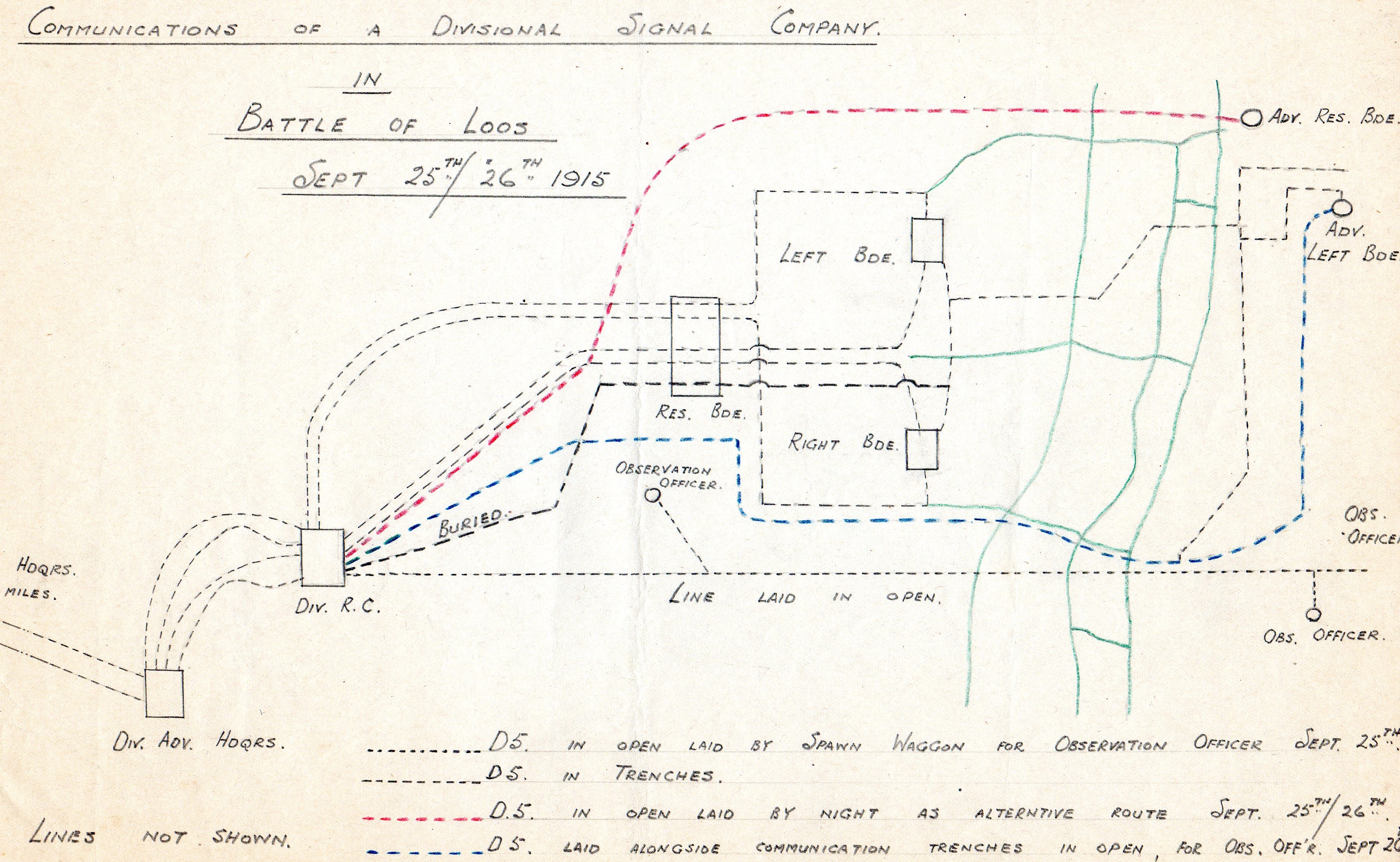
COMMUNICATIONS OF A DIVISIONAL SIGNAL COMPANY

COMMUNICATIONS OF A DIVISIONAL SIGNAL COMPANY


DURING THE BATTLE OF LOOS


PREPARATORY.  Division Fighting Headquarters were in dug-outs about 2000 yards behind the front line, with Advanced Division Headquarters about 1 ½ miles, and Division Headquarters 6 miles to the rear.


LINES BACK.  Four lines, partly poled cable, partly buried and partly pinned in trenches were laid from Advanced Division Headquarters to Division Report Centre.  These lines provided two telephone (earth return) circuits back to Advanced Division, one vibrator circuit and one line “spare”.  All telephone work was transmitted at Advanced Div. Headquarters, “G” messages being given “priority”, and this arrangement worked satisfactorily all through the Battle.  It was found, however, that telephone calls from the Corps were unduly delayed and during the morning of after assault, the Corps ran a pair of wires with ring telephones direct to the Staff dug-out.  Sounder working was not used forward of Advanced Division Headquarters.

The C.R.A. had a separate Signal Office, with two lines back to his Headquarters Exchange (which was near Advanced Division Headquarters) and communication forward to his Group Commanders with Infantry Brigades, who were connected with to group exchanges.

At no time during the Battle was there heavy shelling behind the line of the Divisional Report Centre, and the lines therefore were very little broken.  Test points with line men had however, been provided at two intermediate points, but these proved superfluous and were soon called in.

Considerable trouble was experienced during the time preceding the battle through rearward trenches being used to accommodate working parties, which not only pulled down the wire but burnt off most of the insulation with their cooking fires.

It is recommended that, if at all possible, one or two poled cables along the sheltered routes be provided at least as far as Divisional Report Centre.  This ensures good telephone communication up to this point, no matter what the weather may be like and, should the Divisional Headquarters advance, they provide a point from which wires can be easily extended, and facilitate taking over should the Division be relieved.


LINES FORWARD.  Brigade Headquarters were in dug-outs about 700, and the Reserve Brigade Headquarters in a farm cellar about 1,000 yards behind the first line trenches.  Three wires were taken by different routes to each Brigade Headquarters to provide one vibrating line, one telephone line, and one ‘spare’ – the ‘spare’ being a buried line (three feet deep) common to the two front Brigades.

The Reserve Brigade had tees off all these lines and so was in direct touch with the front Brigades, but it would have been better had it had a separate line in addition.

These lines were very little broken at any time during the bombardment or battle.  On the day of the assault, however, it turned out very wet (after a long period of dry weather) and some of the older trench lines gave indifferent signals, so the buried line, which was excellent was chiefly used for the telephone.  Though for the first day this buried line was not broken, it was subsequently cut to bits through fire directed on a battery which, advancing, sighted itself in close proximity to the buried route.

Brigade lines to Battalions, and Battalions lines to Companies were all pinned and knee height in trenches, with staples about every 10 feet.  Alternative lines were arranged, and these lines all stood up very well, the bulk of the enemy fire being directed on our front system of trenches.

The parties carrying up Gas Cylinders during the night prior to the assault necessitated constant maintenance of the lines.


ORDERLIES.  Each Company furnished orderlies to Battalion Headquarters, and each Battalion furnished orderlies to Brigade Headquarters and each Brigade furnished orderlies to Divn Headquarters.

These orderlies were used as despatch runners, assisted in carrying signalling equipment, and were available in case communication by wire was interrupted.


THE ASSAULT.  By direction of the General Staff, the supporting line laid two wires per assaulting Battalion as they advanced.  D 1 was used for this purpose.  Actually only one of the wires so laid was over through and that only for a few minutes.  Subsequent examination discovered that most of the men who were laying the lines had been killed.

It is not recommended that any wires be laid forward to enemy trenches till we are firmly established therein.

The assault of the left Brigade at daybreak was successful.  The assault of the right Brigade was hung up till the afternoon.


ARRANGEMENTS FOR ADVANCE OF BRIGADE HEADQUARTERS.  Brigade Sections were provided with two light Indian drums of D 5 wire (each drum carrying about ¾ a mile of wire) with which to extend themselves in case of an advance.  These drums were carried on light stretchers made locally.  The onus of leaving one good line behind them was laid on each of the forward Brigade Sections, the Reserve Brigade being warned to come in on one of these lines should it advance, and to further extend it should pass beyond the assaulting Brigades.

Strict injunctions were issued to Brigades that, should they advance, they should on no account, close down their signal office till another office has been opened in their new position, and secure communication established thereto, and that until such time as the new office had been established they should work from the old Signal Office by orderly.  Though these instructions were carried out it was found that an insufficient number of orderlies to keep satisfactory touch with Brigade Headquarters when it advanced were left behind, and further that these orderlies who were left behind  did not always know in which direction to look for their advanced headquarters.

Orderlies should be picked men – selected for their intelligence and zeal, and should a move take place they should be carefully instructed as to where to look for new Brigade Headquarters.


LEFT BRIGADE.  The Assault of the left Brigade being successful, the Brigadier moved from his report centre almost at once, moving first to a former Battalion Headquarters and then to a Company Headquarters and then across “No man’s land” into German lines.  The Brigade extended from the Division, on existing trench lines (previously selected) as far as the front trenches, and thence laid D 5 as arranged, to the German lines and on to new position of Brigade Headquarters.  This line was on the whole satisfactory and was on no occasion dis[connected] for any length of time.

The restlessness of the Brigadier of the Left Brigade did not help towards good communication as his whereabouts were difficult to ascertain.  It is thought that a Staff Officer should always be left at the existing Signal Office till communication to a more forward office shall have been secured.

It is found that some Brigadiers are inclined to use their Signal Officers as Staff Officers and to send them forward to do reconnaissance work.  This practice should be discountenanced.


OBSERVATION OFFICER.  The German trenches were situated on a ridge the capture of which would give a view of the country beyond.  At the last moment the Staff decided to send forward a Staff Officer to observe and keep the G.O.C. informed direct on the situation.  A line was demanded to his observation post and it was suggested that when he advanced, a signaller should accompany him and ‘run a line’ to whatever position he should take upon the captured ridge.  This meant an extension of some two miles in length!  The signaller was also to carry visual equipment in case the line should go!

No time was available to lay a trench line to front trenches from which an extension could be made.  To meet the Staff requirements, therefore, a D 5 cable was laid during the night preceding the assault on the ground in the open from the report centre straight toward the German lines.  About a thousand yards of cable was so laid, and a T off of D 3 was laid to the selected observation post which was in an old trench some few hundred yards away.  As soon as the German trenches were captured, the observation officer was to move forward.  To provide the extension required, a party was made up consisting of an officer, an N.C.O., and two men (all visual signallers), and a driver with horsed ‘spawn wagon’ – a local construction – carrying a drum of D 5 cable, a drum of D 3, and visual equipment.

This vehicle consisted of an airline barrow with extra wide flanges shrunk on to the wheels, an extended axle to provide a wider wheel base and more stability, angle iron handles and wooden shafts.

As soon as the Observation Officer announced by telephone that he was about to go forward, this party sallied forth and met him at the point to which the line had previously been laid, extending on the line from there as they went forward.

The move forward, however, proved somewhat premature, for the attack of the Right Brigade, towards the centre of which the line was being laid, had been held up.  The party came under machine gun fire when about five hundred yards from our front line.  The barrow was upset and the horse was wounded and broke away (to return almost immediately to his picket line).

The party took refuge in a trench and opened an office from which the situation was reported.

In the afternoon after the surrender in front of, and the subsequent advance of the right Brigade, the ‘spawn’ wagon was righted and pushed forward by hand as far as the German wire.  (Note: The line had been laid beside a track which had previously been bridged over trenches to permit of the advance of artillery).  On reaching the German wire, an extension with D 3 cable was made to the top of the ridge to the selected observation post.  Valuable information was furnished by means of this line which gave excellent signals.  The officer i/c of the party was therefore instructed to extend it in German Trenches to the new left Brigade Headquarters.  This was successfully accomplished and the line was used thereto as a speaking line.  During the first day of the battle this line was only cut two or three times.

The observation officer returned to Headquarters at dark

RESERVE BRIGADE.  Towards late afternoon the Reserve Brigade supported the Left Brigade, its Headquarters moving to a dug-out within about a hundred yards of Left Brigade where it came into circuit on one of the existing lines.

To provide alternative communication, a party with a second ‘spawn’ wagon, carrying two drums of D 5 was sent out after night fall under an officer to lay a line by a different route to the advanced position of the Left and Reserves Brigades.

This line which was over 3 miles in length, was successfully laid alongside communication trenches.  The party returned with the ‘spawn’ wagon without casualties.


Right Brigade.  The attack of the Right Brigade had been held up till late afternoon when the surrender of the enemy in front cleared the way and the Brigade swept forward.  Brigade Headquarters advanced in one bound to a point about 1 ½ miles beyond the German front line, extending as it went with D 3 from the advanced position taken up by the Divisional Observation Officer.

Repeatedly broken by shell fire and repeatedly repaired, no useful results were obtained from this line, which was only through for a very few minutes.

Divisional Headquarters now talked about a move forward, and a cable detachment was sent to lay a line from the point selected for new Headquarters to the Right Brigade.  This detachment met a crump, was unable to find the bridges across the trenches in the dark, and returned.  Orders, however, had been received meantime that the Right Brigade would be relieved, and the Brigade returned to its old Headquarters in our trenches, coming back in circuit on the old lines.  The projected move of Divisional Headquarters was therefore abandoned.  During the night Signals on the line laid, in the first instance, for the Observation Officer began to fail, owing to the passage of advancing Artillery, and before morning the line had been cut to bits and had to be abandoned.


Second Day.  The Left Brigade was to continue the attack.  Staff decided to again send out an observation Officer, and it became necessary to lay another line.  Profiting by the previous days experience the line was this time laid (by a spawn wagon party) close to a communication trench so as to be out of the way of traffic.  It was successfully laid, gave good results, and was subsequently extended to Left Brigade.

The second line which had been laid by spawn wagon the first day was now constantly getting broken by shell fire.  An Officer was therefore sent out with a party and arranged for two test points, by means of which faults were quickly localised and repaired.

This arrangement worked admirably.


Visual.  Visual from a station near Divisional Fighting Headquarters to Brigade Headquarters was arranged for and tested.  It was not however required, as the lines stood up.  It was arranged to send forward another station to the captured ridge should the brigades advance beyond, and communication by wire fail.

Actually the long advance of the Right Brigade came rather suddenly, and before the visual station had got out (some 2 ½ miles over deep mud) and got into touch, the Right Brigade was relieved.  As it turned out the night was misty and visual would have been doubtful.  The visual stations were supplied by Divnl. Cyclist Company.

It is recommended that in order to keep in touch with Brigades which advance quickly, as did the Right Brigade, a visual station be pushed forward to some suitable forward point to which communication has been established by wire.  It is thought that communication by wire will prove impossible.

The visual station should be held in preparedness as far forward as possible.

A certain amount of visual by flag and lamp was used between brigades and battalions.  Between Battalions and Companies, 8” home-made wooden discs were used.


Wireless.  A trench set was allotted to the Left Brigade, and was to accompany Brigade Headquarters when they advanced.

Actually at the moment of the advance the shelling was so heavy that the brigade section officer decided to leave the set behind and to send for it later.  It would probably however have been better to take it along in the first instance, for considerable time was lost later on in finding it and getting it to new position of Brigade in the German lines.

It was finally set up just behind the ridge and got into touch with the parent pack set.  The aerial was only broken once or twice.  Actually no messages were sent by wireless.


Pigeons.  Each Brigade had a Pigeon station.  The only time, however, that communication by such means would have been useful was when the Right Brigade pushed right forward, and it was then night.


General.  The resources of the Company were very much strained through having to arrange for, equip, and man three distinct headquarters.

It should be impressed on the Staff that after brigade headquarters advance beyond their fighting positions, they will be lucky if they have one line through to each brigade, and that talking should be cut down as much as possible.

The example of the General Officer who, in the middle of a battle wrote a message of 138 words, dictated it personally down the telephone, and then handed it to Signals for transmission, is not one to be emulated.

Much time is frequently lost in delivering messages owing to the difficulty in finding brigade and other headquarters.

Signal Officers should bear in mind the necessity of signalising the presence of their Signal Office.  Flags Distinguishing Telegraph should be carried, and it is even advisable to place orderlies at junctions to direct message carriers to headquarters.

It is thought that the importance of arranging visual to keep communication during an advance cannot be exaggerated.

The “Spawn Wagons” proved invaluable.  In case of necessity the horse can be unhooked and the wagon lifted across a trench.

Every Divisional Signal Company should have them.

The routes to be bridged over our own and the enemy’s trenches should be carefully ascertained beforehand, as it may become necessary to send out a Cable detachment or a spawn wagon party.

No means on maintaining communication should be neglected.

The Motor Cyclist with the Signal Brigade managed to get his bicycle forward and it proved invaluable.

Where the enemy trenches are on a ridge, Brigadiers will almost certainly want to move forward as soon as the ridge has been captured.  This should be foreseen and extensions prearranged.  Signal Officers should not neglect to inform offices working to them of any impending or projected move.  Should they at any time not be working direct to headquarters they should keep headquarters informed as to where messages for them should be sent for delivery.

It was found that lines carefully pinned Knee-height in trenches gave good results.  Gunner lines laid, in spite of all advice to the contrary, outside trenches, were absolutely useless.

The assembly of the attacking force in, and the subsequent passage of supports through the trenches renders continued maintenance essential, if the line are to be used for extension after the advance.

Lines laid on the ground or buried in shallow trenches across bare open ground which is not likely to be crumped often give most excellent results.  Trenches through places likely to be crumped should not be less than 6 feet deep.  Three feet trenches if used should only be half filled in.  The advantage of this is that while fill protection is obtained against shrapnel fire, the trench is always easy to follow, and the wires are easy to find.

Moreover the unfilled portion of the trench gives a certain amount of confidence and protection to the linemen.

It has been found that where labour in not forthcoming to dig a deep trench through a crumped area.  Shallow open trenches give good results.

It should not be forgotten that two mounted Despatch Riders were found necessary and authorised for Brigade sections during the retreat.  These, and the mounted despatch riders belonging to Divisional Headquarters should be available in immediate readiness.

It is more than probable that in a moving fight these will provide the only possible means of rapid communication.


 2 Plan with report