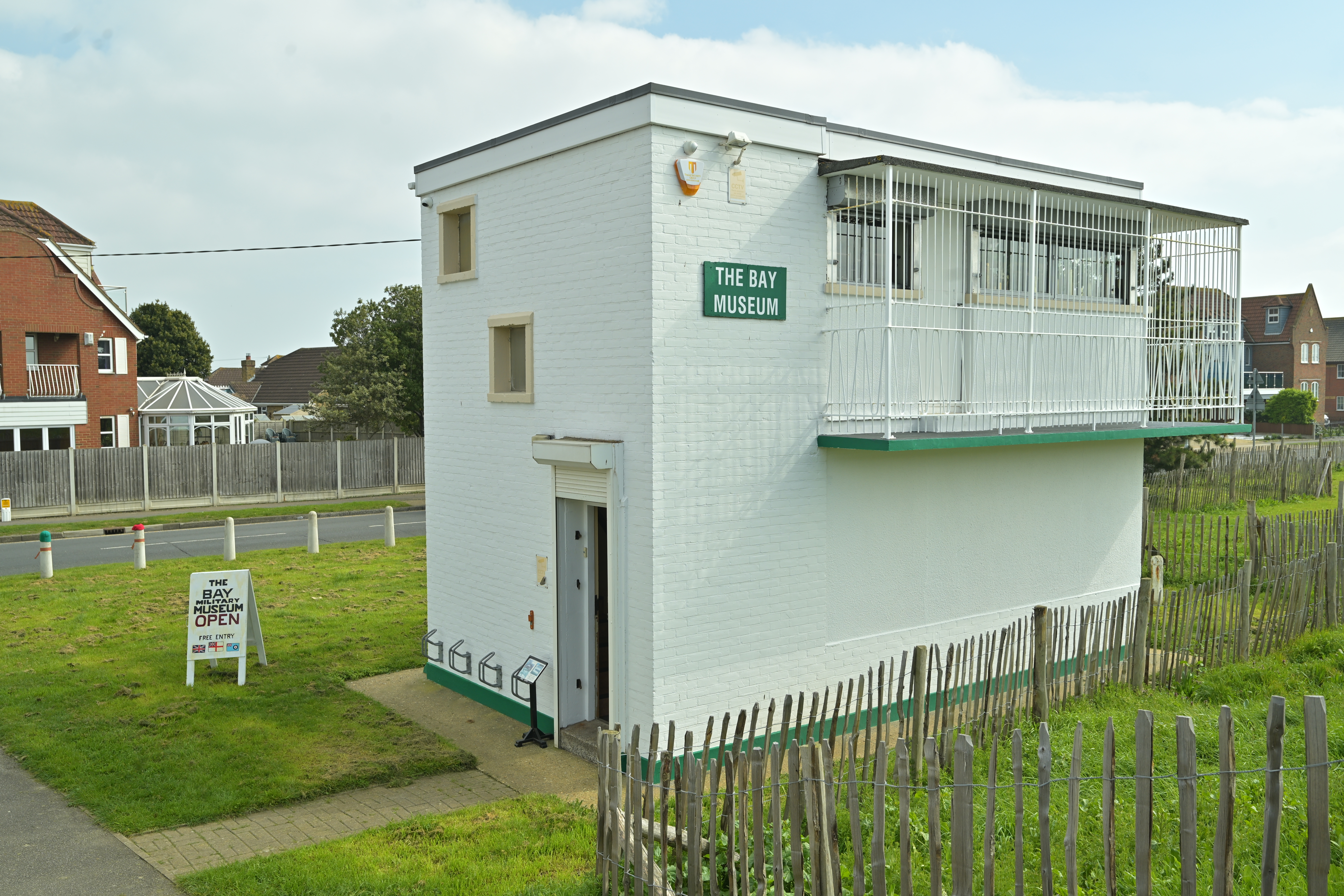
The Bay Museum is a friendly museum situated on Canvey Island. Based in a degaussing station, it now offers a wealth of artefacts, books and displays focusing on both local and world military history focused on the First and Second World Wars. Open from 10am till mid-afternoon on Sundays, the museum is run by our volunteers who always warmly welcome visitors and are willing to impart their knowledge. They can also help you research your own family military histories and have extensive experience of visiting battlefields and cemeteries. Our website contains information about visiting the museum as well as archiving wartime records that we regularly transcribe online.
THE BAY MUSEUM AND RESEARCH FACILITY
CHARITY NUMBER 1204193
TRUSTEES
CHAIRMAN: D. THORNDIKE VICE CHAIRS: J. HARRIS & A. REED SECRETARY: G. BAKER TREASURER: M. DANIELL
First of all I must thank you a whole lot for the magnificent ‘celebration’ cake which arrived on Thursday – it is an absolute beauty and there is no sort of doubt that it is the very best ever – I am eking it out ever so carefully. During the week I’ve had 2 most welcome letters from you, dated the 12th and 15th – please thank the various senders of kind messages to me and say that I will not be writing (!) but hope to see them soon. You seem to have been anything but an ‘Ellsworth’ recently, and hope you really will get down to see Aunt Beth at the beginning of March – Eileen told me of her visit, only fairly successful, to London, the other day, and that she had bought some theatre tickets for you – the housewives deserve and need as many excursions of this kind that they can get – well done the housewives!
The weather has been absolutely haywire here this week, sun rain snow wind and a thunderstorm! The one day when we wanted it reasonably fine was Wednesday, when we went off to BOCHUM to play 3 Medium Regt in the first round of the Rhine Army Inter Unit competition – during the morning it kept clearing up after periodic blizzards, and we went over after an early lunch. We had one blizzard in the first half and there was a bitter wind but it cleared up, and half way through the second half, when we were leading 3-0 another blizzard started, it got very dark, thundered, and this time didn’t clear, so we had to abandon the game. That evening Peter Royle came over to have dinner with me and we had a most enjoyable evening, including a good old natter about the days in the 17th. Table tennis activities were confined to Tuesday evening when Leonard Olney and I had 2 matches, one at the Local General Hospital for the Corps HQ team, and the other at the barracks against another branch. We both won our games at the Hosp and again up at the Barracks, where our win has just us at the top of the Inter-Branch league.
I was asked to play 2 matches this weekend in Brussels for Rhine Army v the Leopold Club and after a lot of harring and humming I decided not to go – it would have been very difficult as Martin Buick is away, and this is Leonard Olney’s last weekend, and at the time of my refusal there was no sign of a new G3 to replace him – he has arrived now, and Leonard goes on Tuesday. If the weather in Brussels is anything like it has been here this weekend they will not have played – it has been snowing on and off (mostly on) since Friday and there must be at least 6 ins on the ground now. As luck would have it we had no hockey arranged for this weekend and I spent most of the time since lunch yesterday (Saturday is now officially a half-day) either asleep(!) or sorting my kit out, in a fortnights time today (DV) I shall be ‘on my way’ with next stop HOME, and that thought caps all others now, home for ever – whoopee! After all this I nearly forgot to thank you for the letter which arrived this morning, dated the 19th I was very interested to hear about the Memorial Service for Hugh. So I shan’t have the please of seeing you in the ‘demobbed’ mac – Busby did well to get it for £2 – but I still don’t like the ww at the back of the macs! Are Ma and Pa J back at Mistley Place now? or have they retired?
In the work line I’ve been very busy again this week and shall continue to be until my relief comes in tomorrow week. I shall be delighted to make his acquaintance! I had a long chat with John Stephens on the phone the other day – he had got some letters from Hamburg for Nora King and he tells me he has sent them to you – one of his officers went up there recently. He is coming up to have dinner with me on Thursday. Well, little Maz, I must away and hop into a much needed bath – only 18 more days now. I’m so longing to see you again, my love to Pari and Brian, much love to you,
Yours as ever
very affectionately
Peter
In envelope headed ‘O A S’ addressed to Mrs Gerald C Benham, 5 Oxford Road Colchester Essex.
Postmarked FIELD POST OFFICE 734 dated 26 FE 46. Signed P.C. Benham.
On front of envelope Written Feb 24th 1946 rec March 2nd 1946 (11)
Much to my surprise there was a mail both yesterday and today – surprised because the weather just couldn’t have been much worse – and in yesterday’s post your Tuesday letter and PC written in Harrods arrived, today your Thursday letter came. You must surely be second to none in the letter writing line and I was delighted to hear all your news. Your London trip may have been an abortive sortie from the shopping point of view but the day in Town will have done you good – would that I could have been with you. Yes, as you so rightly say I could suggest at least one place where you could put the marmalade, but it would not be very practicable, so will refrain. I have however put me thinkin’ bonnet on and there appear to be three places (a) sitting room (b) spare room (c) cupboard under Thorburn’s stairs.
The latter might be possible but only if you could erect some sort of shelf in either of the 3 following places. Illustration. Do you get the general idea or am I being rather as ass! Anyway its food for thought. I loved your excellent account of the day in London, only you can write an account of a day in that way – I was able to imagine you the whole time. I’m glad the taxi driver only got his fare! I had hoped to hear good news of a titfer and hope you may be successful yet – I was conjuring up visions like this: – illustration small, plain, grey felt. I may still be being an ass, but it’s more food for thought!
Darling, I wonder how old man Geernaer is coping with my suits – any news from him? Unless he gets a slight shift on I’m only going to have me de-mob outfit to wear for quite some time, and it will soon develop sag-arse, shiny seat and baggy knees! I’ve done very little since lunch-time yesterday – but feel that the rest and relaxation has done me good – I had planned a bit of a walk yesterday pm but it was sleeting hard all the afternoon, and, I kept well inside – I did a real spring clean of my room, have packed up the odd parcel, destroyed masses of old junk which I had accumulated during the past two years, junk which has now gone for a 100% Burton. Nothing in that line will find its way to The Crescent that I promise you, and I’m being absolutely ruthless about it all. Literally the only thing, apart from cleaning up, and 20 winks I had this pm, I’ve done since lunch-time yesterday have been a sojourn to the office this morning and a bath just before I started writing this letter. In a blinding snow-storm this morning I walked up to the office where I got myself organised for the inevitable Monday morning (only one more in this army after tomorrow!) and I walked back to the Mess just before lunch – there must be at least 6 – 7 ins of snow and I came back in a most undignified manner. Dick and Ted are down at the skiing centre at Winterberg, so things are pretty quiet here. This afternoon I more or less completed my sorting out of kit, did up another couple of parcels (one of pants, vests etc and the other law books). I heard this morning that this bloody awful weather has caused a day’s postponement in release sailings, but I’m told it only affects the current release group (Gp 24), so all is well for the 11th – just 18 more days, my angel, and my whole being now revolves round our D day, my excitement and impatience know no bounds, and my thoughts and concentration are entirely ‘one-tracked’ – the track being YOU, my darling, and the heavenly thought of the resumption, this time never-ending of our partnership together – exciting, exhilarating thought. Dearest girl, I must away to dinner which will be followed by a very early night.
God bless you, my sweet girl, and keep you always, and let these 18 days go very quickly. I love you, dear heart, more than ever and live just for you. ALL my love is yours for ever and always
Peter
In envelope headed ‘O A S’ addressed to Mrs Peter C Benham, 9 Vint Crescent Colchester Essex.
Postmarked FIELD POST OFFICE 734 dated 26 FE 46. Signed P.C. Benham.
INDIRECT LAYING SYSTEM IN USE BY BRITISH EXPEDITIONARY FORCE IN FRANCE.
The site for the Battery and general directions in which fire will be required having been ordered, the line of guns are placed approximately at right angles to this line.
If covered emplacements are built, it is very important that each dial sight should be able to see the aiming point.
The gun on one flank is usually chosen as directing gun. The corrections for the other guns will be simpler if the aiming point is at right angles to the line of fire, but it is very difficult to make a covered emplacement which allows of this. In the battery I saw, the aiming point was 45o right of rear.
The exact position of the directing gun is then marked very accurately on the map, and a line drawn through it for a normal axis of fire. This is called the zero line. Also a line on the aiming point – the angle between these two is then measured by the dial sight.
If the zero line can be laid on a seen object marked on the map, there will be a chance to check accuracy. The distance between the guns is then carefully measured, and the angle between the aiming point and the zero lines calculated. This should bring all the zero lines parallel, and pickets on which lamps can be hung are placed to mark them.
A line is drawn on the map behind the enemy’s position at right angles to the normal axis of fire; and degrees right and left set off along it, as calculated from the directing gun.
A paper straight edge is pivoted at the directing gun, and when this is brought over the target, the angle right or left of the normal axis of fire can be read off on the scale of degrees.
A scale of ranges, allowing for the shooting qualities of the cordite in use, is marked on the edge of the paper straight edge, and immediately gives the range of the target from direction gun. When this is known, the correction in line to concentrate the other guns on target is easily got from a table.
To get the exact line – only a cross wind need now be allowed for.
To get the elevation – a headwind, barometer and thermometer corrections must be made. Also for difference of level of gun and target, if any.
After the first shot, the forward observing officer signals corrections.
Aeroplanes directing guns first signify the target by the usual map nomenclature by wireless.
After the first shot, they signal the angle from north and the distance of the spot where they wish the next shot to fall.
The Battery Commander has a scale and circular protractor device by which he can readily calculate the necessary corrections in angle and in elevation for his guns.
INDIRECT LAYING SYSTEM IN USE BY BRITISH EXPEDITIONARY FORCE IN FRANCE.
The site for the Battery and general directions in which fire will be required having been ordered, the line of guns are placed approximately at right angles to this line.
If covered emplacements are built, it is very important that each dial sight should be able to see the aiming point.
The gun on one flank is usually chosen as directing gun. The corrections for the other guns will be simpler if the aiming point is at right angles to the line of fire, but it is very difficult to make a covered emplacement which allows of this. In the battery I saw, the aiming point was 45o right of rear.
The exact position of the directing gun is then marked very accurately on the map, and a line drawn through it for a normal axis of fire. This is called the zero line. Also a line on the aiming point – the angle between these two is then measured by the dial sight.
If the zero line can be laid on a seen object marked on the map, there will be a chance to check accuracy. The distance between the guns is then carefully measured, and the angle between the aiming point and the zero lines calculated. This should bring all the zero lines parallel, and pickets on which lamps can be hung are placed to mark them.
A line is drawn on the map behind the enemy’s position at right angles to the normal axis of fire; and degrees right and left set off along it, as calculated from the directing gun.
A paper straight edge is pivoted at the directing gun, and when this is brought over the target, the angle right or left of the normal axis of fire can be read off on the scale of degrees.
A scale of ranges, allowing for the shooting qualities of the cordite in use, is marked on the edge of the paper straight edge, and immediately gives the range of the target from direction gun. When this is known, the correction in line to concentrate the other guns on target is easily got from a table.
To get the exact line – only a cross wind need now be allowed for.
To get the elevation – a headwind, barometer and thermometer corrections must be made. Also for difference of level of gun and target, if any.
After the first shot, the forward observing officer signals corrections.
Aeroplanes directing guns first signify the target by the usual map nomenclature by wireless.
After the first shot, they signal the angle from north and the distance of the spot where they wish the next shot to fall.
The Battery Commander has a scale and circular protractor device by which he can readily calculate the necessary corrections in angle and in elevation for his guns.
INDIRECT LAYING SYSTEM IN USE BY BRITISH EXPEDITIONARY FORCE IN FRANCE.
The site for the Battery and general directions in which fire will be required having been ordered, the line of guns are placed approximately at right angles to this line.
If covered emplacements are built, it is very important that each dial sight should be able to see the aiming point.
The gun on one flank is usually chosen as directing gun. The corrections for the other guns will be simpler if the aiming point is at right angles to the line of fire, but it is very difficult to make a covered emplacement which allows of this. In the battery I saw, the aiming point was 45o right of rear.
The exact position of the directing gun is then marked very accurately on the map, and a line drawn through it for a normal axis of fire. This is called the zero line. Also a line on the aiming point – the angle between these two is then measured by the dial sight.
If the zero line can be laid on a seen object marked on the map, there will be a chance to check accuracy. The distance between the guns is then carefully measured, and the angle between the aiming point and the zero lines calculated. This should bring all the zero lines parallel, and pickets on which lamps can be hung are placed to mark them.
A line is drawn on the map behind the enemy’s position at right angles to the normal axis of fire; and degrees right and left set off along it, as calculated from the directing gun.
A paper straight edge is pivoted at the directing gun, and when this is brought over the target, the angle right or left of the normal axis of fire can be read off on the scale of degrees.
A scale of ranges, allowing for the shooting qualities of the cordite in use, is marked on the edge of the paper straight edge, and immediately gives the range of the target from direction gun. When this is known, the correction in line to concentrate the other guns on target is easily got from a table.
To get the exact line – only a cross wind need now be allowed for.
To get the elevation – a headwind, barometer and thermometer corrections must be made. Also for difference of level of gun and target, if any.
After the first shot, the forward observing officer signals corrections.
Aeroplanes directing guns first signify the target by the usual map nomenclature by wireless.
After the first shot, they signal the angle from north and the distance of the spot where they wish the next shot to fall.
The Battery Commander has a scale and circular protractor device by which he can readily calculate the necessary corrections in angle and in elevation for his guns.
In every battery of horse, field, heavy, and mountain artillery, there should be at least three qualified layers per sub-section, exclusive of sergeants and corporals. A list of these layers will be kept by the Battery Commander. All qualified layers, and also all sergeants and corporals, should be tested periodically.
All section commanders and Nos. 1 must be thoroughly conversant with: –
The tests for sighting gear and sights;
The method of obtaining a line of fire parallel to that of a named gun;
The care of the telescope and dial sight.
Layers will be tested by means of two tests, “A” and “B”. Test “A” will consist of four lays “direct”; Test “B” of three lays “indirect”. An example of the two tests is given in Appendix I.
A maximum of 10 marks will be given for each lay. In order to qualify, a layer must obtain a total of 56 marks for seven lays.
Each layer should be tested with his own No 1. If for any reason the No 1 is not available, his place will be taken by the non-commissioned officer of the same sub-section who would normally replace the casualty.
The order in which the tests are laid down below is not to be adhered to rigidly, but should be changed when each new layer takes his place at the gun. The layer to be tested should be given no indication as to what sight or method of laying is to be used until he takes his place at the gun and receives the actual order.
The examiner should be assisted by an officer or senior non-commissioned officer with a stop watch and record book, and by a penciller who will take down all orders given, for reference when checking the lay.
Before beginning the tests at least five targets will be selected in the foreground at varying ranges and angles of sight, and covering a front of about 25 degrees. Except in the case of gun targets these should as far as possible be natural features of the ground. If it be necessary to utilise dummies, they should be placed in positions such as the troops which they represent would naturally occupy on service. A reference point, approximately in the centre of the target zone, will be pointed out to the No. 1 and to the layer. Throughout the tests targets will be pointed out with reference to this point by means of the clock code.
When laying direct on any target (other than a gun target) which extends over a fairly wide frontage, great exactitude in direction will not be required as regards the point originally selected to lay upon, which may be anywhere in that portion of the target opposite to the gun being laid. Any subsequent lays on the same target must, however, be on the same point as the first.
When the layer has taken his place at the gun, the caution “Represent No…. gun in action” will be given, followed when necessary by the caution “Open sight,” “Telescope sight,” or “Direct laying, Dial sight.” The orders for the lay must then be given out by the examiner clearly and distinctly, a short pause being made after each separate order, thus: – “Aiming point, Church spire, 20o right” – pause – “Concentrate 20’ on No. 1,” – pause – “Angle of sight 1o 20’ elevation,” – pause – “4,200.” All orders will be acknowledged by the No. 1 as laid down in Field Artillery Training. Should the layer at any time be in doubt as to a particular order he will refer to the No. 1 who may repeat to him any part of the orders received.
After checking a lay the examiner will elevate the gun about 15 minutes in order to represent the movement of the gun after firing.
In the case of a switch the brake must be taken off and put on again using the quick release lever (if provided).
In equipments which require two men to manipulate the gears, layers will be examined in pairs and for any incorrect part of a lay marks will be deducted only from the individual making the error.
The times allowed for each lay with the various equipments are given in Appendix II. The layer will call out “Ready” as soon as he has finished laying the gun. The time will be taken from the commencement of the orders for the lay until the word “Ready” from the layer.
One mark will be deducted:-
For every five seconds or fraction of five seconds beyond the time laid down in Appendix II for the particular lay;
If the traversing gear is not within thirty minutes of zero (in cases where this applies);
For each mistake in the manipulation of the sighting gear or in the drill of the layer as laid down in the “Section Gun Drill.”
No marks will be given for the lay:-
If the sight is incorrectly set;
If the gun is not correctly laid for elevation and within five minutes for direction;
If the clinometer bubble * is not in the centre of its run;!
If, by pressing on the breech of the gun, it is found that the last motion of the elevating gear has not been one of depression;
If the bubble of the cross level is not wholly visible in its run (except when laying with sights which are nor reciprocating). #
* The bubble of the longitudinal level in the case of 15-pr. Q.F. and 15-pr. B.L.C.
! The bubble of the sight clinometer (or longitudinal level in the case of the 15-pr. Q.F. or 15-pr. B.L.C. gun) will be levelled as soon as the gun is laid:-
When laying direct in the case of:-
15-pr. Q.F. gun,
15-pr. B.L.C. gun,
13-pr. Q.F.gun,
18-pr. Q.F. gun,
2.75-inch B.L. gun.
When laying direct with the dial sight, but not with the open sight, in the case of:-
4.5-inch Q.F. howitzer.
When laying direct with the dial sight or by the telescope, but not with the open sight, in the case of:-
60-pr. B.L. gun
It is never to be done in the case of:-
4.7-inch Q.F. gun,
2.95-inch B.L. gun,
10-pr. B.L. gun,
5-inch B.L. howitzer.
Reciprocating sights correct automatically for difference in level of wheels.
APPENDIX I
EXAMPLE OF TESTS
TEST A. DIRECT
Examples of Cautions and Orders Lays.
Cautions.
“Represent No. … gun in action” 1 The sights are set as ordered, and the target is picked up by the layer, assisted by
“Open sight” the No. 1 at the traversing lever. The pointer of the traversing gear should not be more than 30’ from zero when the lay is completed.
Orders
“Infantry lining hedgerows” The bubble of the clinometer or longitudinal
“4 o’clock, 3o to 5o” level must be levelled after the gun is laid and before reporting “Ready.” With heavy
(Elevation) “……” guns No. 1 directs the gun to be traversed by handspikes or by dragropes.
As soon as the lay has been checked by the examiner, he should set the deflection
scale to some graduation and note the reading. In the next lay the layer must set
sight “more right” or “more left” from this graduation.
Orders.
“1o 15” more left.” 2. The sight is re-set as ordered and the gun relaid on the same part of the target as
(Elevation) “…..” in 1, the clinometer bubble being again levelled if necessary. The traversing gear is to be used if provided.
Cautions
“Telescope Sight,” 3. The target is to be picked up, laid on, &c.
or as in 1, but the opposite gun must be laid
“Direct laying, Dial Sight.” on. The bubble of the clinometer must be levelled as in 1.
Orders
“6-gun battery”
“8 o’clock 4o”
(Elevation) “………”
4. The laying is tp be carried out on the
“2o 20” more left” same principle as in 2.
(Elevation) “……….”
TEST B. INDIRECT.
An aiming point is pointed out to the No. 1 and an aiming post number is to stand
ready at the gun with the aiming posts.
Examples of Cautions and Orders Lays.
Orders
The line of fire is laid out as laid down in
“Aiming point …..” “Section Gun Drill.” The gun is laid for elevation.
“Lines of fire 20o right.” The pointer of the traversing gear (if provided) is not to be more than 30’ from
“Angle of sight 1o 30’ elevation.2 zero when lay is completed.
(Elevation) “…..” The signal for the aiming post number to come in should be given by No. 1 on the layer reporting that the posts are correctly planted.
Orders
“All guns 10o more right” 2. The sight is re-set as ordered and the
“Raise angle of sight 20’” gun re-laid on the aiming posts by moving
(Elevation) “……” the trail. The pointer of the traversing gear should not be more than 30’ from zero.
Cautions.
“Represent No. …. Gun in action2 3. The dial; sight is set as ordered and the gun laid as in “Section Gun Drill.” The layer
Orders. will then pick up a suitable auxiliary aiming
“Aiming point …….” point to lay on for subsequent rounds.
Just a few lines to let you no how I am enjoying soldiering life and I think it is time every young able men ought to join the colours at once and not to wait till they are fetched and if it had not been for my business I should of been here before now I think it is grand and I am enjoying it down to the ground, but I expect you no it is not all honey but never mind we have to put up with things sometime when we don’t want to and that is with it in my case I have been moved from the first place I went to, and the second place I have been send to Brompton Barracks not far from the first station and Fred Hall has gone nine mile away from me so you see I have lost my pal and the pals I’ve got is a Irishman and a Scotsman and it takes me all my time to tell what they are talking about its awful for people to understand what they are saying. I expect Miss Needham has told you we are going to get married and I should like to have been married before I joined the colours so as to get things in her line and you see I shall have not much time to tell her about things I want to do and if she had been married when I wanted to be their would have been a chance of getting out of it but I am glad I am in the colours and Whitwick people can’t say you don’t do anything in this war that will be the first thing they will bring out so I can I have tried to do my share and that’s what a good many can’t say. Do you while I was drill on the square I saw another Whitwick chap and it was Gideon McCarthy I was surprised to see him at Chatham so you see I am not the only young man their, there are some fine young men come to St Mary’s Barracks last week and I don’t know what it will be when they are called up in March you will have a job to see a young man in Whitwick and at Church to we all parade to go to place of worship with (R.E. Band) so you see we go to Church asual they tell me there are a lot getting married at Whitwick I don’t know whether it is the war that is making the young chaps getting married or not I suppose it is, I am a little doubtful whether I can get off to be married but I expect you will help me on this occasion you no it is awful to get away from Brompton Barracks at anytime you no they want as much training out of you are they can so I close my letter with the best of luck (just one thing I won’t you to do is to remember me to all) (Also Remember me to Mrs Walters and family)
I remain Dear Sir
Yours Affectionate
Friend
In envelope addressed to Rev Walters, Whitwick Vicarage, Leicester Road, Whitwick, Nr Leicestershire. R.E. crest on back of envelope.
This is my first ‘peaceful’ evening for some days, and I was quite determined to keep it so – someone phoned me this afternoon and asked whether I would like a game of poker this evening, but I said I was otherwise engaged – I am, and I like it! It seems hardly possible that 3 weeks today will, DV, see the dawn of our long awaited D day – after so much waiting and hoping. I am still wondering whether I really am wise to take the exam in November, and for the sake of four months whether to settle in at the office, wouldn’t be sounder policy, it’s all a frightful muddle in my own mind which is still clogged with the hundred and one petty daily problems of this army life. It will all sort itself out in the end I know, but just now it seems right muddly, lass. If we leave here on the 11th March I hae me doots as to being demobbed on the 14th and think the 15th is more likely, and just how between then and the 2nd April we are going to work in a fortnight in Scotland and get reasonably organised for the course. I can’t quite see – I have longed for our holiday, right away and quite alone, more than you could ever guess, and no matter what happens we will get right away somewhere, that is the surest thing that ever happens, but oh! How I wish I could see how we can make it a fortnight without a frightful rush.
It’s been another ‘mad’ day today, sun, wind, snow all chasing one another round the clock, and when I woke this morning it was to find a couple of inches of snow on the ground. I’ve been, as usual, pretty busy all day, and feel thankful to have this wizard evening to myself. There is precious little news from this end though Leonard’s successor, who arrived yesterday evening, seems a good type, but it’s too early as yet to say how he will cope with the job. Dearest, I do so hope you are taking care of yourself and that you are taking things easily still, you mustn’t have black ‘Jacksons’ when we meet, and it will be my constant and pleasant task to see that they never return, you are so terribly precious to me, and I love you, angel, so awfully much – please, darling, if by any mischance we can’t get away for a fortnight, please realise that I shall be just as disappointed as you, and if we decide that Scotland is too far I have another alternative for you to comment on – in August there is a break from the 1st to the 28th, why not lets book up now for 3 weeks at the Royal (Gibson’s recommend a complete rest from books etc.) and why not a week, a 100% Aunt Kate week before the course starts, at that place I’ll not forget, the University Arms, I feel almost certain that Brian would lend us his car for a week, and I’ll have my ‘demob leave’ petrol, and we could have some wizard outings (we’ll not go near Uppingham) – a car for a week away is far better than no car for 10 or 14 days away – I would write straight off (a) to the U.A. and (b) to book up at Dunkeld in August. What do you say, darling? I have planned a really early night tonight and must write a short letter to Brian before I have a pre-bed bath. God bless you, my adorable girl, and keep you – my only wish is that whenever we go, however long for, you are happy, because I shall be too – with you, near you. I’m just a different person and it is only then that I live. My love, angel, is yours, just all of it,
for ever and always
Peter
In envelope headed ‘O A S’ addressed to Mrs Peter C Benham, 9 Vint Crescent Colchester Essex.
Postmarked FIELD POST OFFICE 734 dated 22 FE 46. Signed P.C. Benham.
After a mail-less day yesterday I was delighted this morning to receive your Saturday letter – my darling I have a feeling that you haven’t quite recovered yet from your flu bug, and hope and pray most earnestly request that you take a really good time, and take things very easily. I do so hope your cough is better, a cough can be the most aggravating thing imaginable, can’t it? No matter what happens you must not repeat not have large circles under your eyes when we meet in London – I have great bags under mine at the moment but do not propose to let them stay in situ for long! Darling, there is only one word for all this ‘middle-aged spread’ talk of yours, and that is, balls. How utterly absurd of Joan to say that you were nothing like the WAAF photos of you, of course you wouldn’t be in civilian clothes – you will receive many severe rockets on the subject if you persist in the MI 5 racket when I get back, I’m tellin’ yer strite, I am!
Two hectic days have just flashed by and some quarter of an hour or so I said au revoir to Peter Royle who came over and had dinner with me at the Officers Club, he was in great form, and we had a super natter about this and that. After one of the most hectic mornings ever in which I did a days work in 4 hours, the hockey team set off at 1.30 for Bochum (some 30 miles from here) to play 3 Med Regt in the BAOR knock-out competition. It was a foul afternoon and we had one crack-a-jack hail-storm during the first half, and mid-way through the second half when we were leading 3-0 (it was bitterly cold that most of our hands had gone numb) a terrific storm blew up, it got very dark, the wind was chock-a-bloc with snow and after struggling on for 5 minutes, we had to give up. We weren’t back here ‘til 6.30 when Pete Royle was due to arrive. Yesterday was also busy and culminated in 2 table tennis matches one in the Iserlohn League and a ‘needle’ inter-branch game. Leonard and I played in both and the HQ game was a win 6-0, the inter-branch was also a win, but only just 6.4. Leonard and I won our games in both matches. It was quite good fun but I do look forward to a good quiet evening for a change. I was asked to play hockey for the BAOR team in Brussels on Saturday and Sunday but declined (a) as Leonard will be away for the weekend, (he leaves for release on Tuesday) and (b) I must have a quiet week-end to get my kit sorted out and to relax for a bit. I’m much too old for all this gallivanting about!!
Just over 3 weeks to go now, darling, and the very thought of it makes my blood flow faster and makes me so very excited. I long so very much for the 14th and HOME, our home. I must to sleep, dearest heart, my eyes are only just managing to stay open. God bless you, dearest heart, and keep you. ALL my love is yours and only yours for ever and always
Peter
In envelope headed ‘O A S’ addressed to Mrs Peter C Benham, 9 Vint Crescent Colchester Essex.
Postmarked FIELD POST OFFICE 734 dated 21 FE 46. Signed P.C. Benham.
Phew! What a day, one of the worst ever and I now feel like a piece of chewed string. Up to 11 ocl I had nothing but calls from the Chief of Staff, ‘have you got so and so ready?’, ‘Are the maps marked?’ ‘Have such and such details available ’! from 11-1.15 I was making notes of the Conference, (all the red flannel in Europe was there), and from 2.30 – 7 ocl I was drafting the minutes and again between 8.30 and just now I’ve been checking the draft and trying to catch up on me days work. Luckily I’m duty officer I think! Still things might have been ‘worser’ and I’ve certainly earned my pay today. Possibly thinking about today’s jobs I just couldn’t get to sleep last night and kept having to put the light on and smoke a cigarette – I was reasonably early to bed but it must have been well after 0200 hrs by the time I got to sleep – it was one of those nights when my pyjama pants kept riding up and having to be pulled down – on such occasions I always wish most fervently I wore a nightie – you’ve no idea how lucky you are! or have you? My mind just cavorted round what seemed to be the never ending problems ahead, it flitted nimbly from today’s conference to our holiday, to the Gibson’s course, the exam, the office and back to the conference and so all over again – as the hours clocked by so did I wonder the more whether it is really wise for me to take the exam in November, or whether it wouldn’t be better to work in the office ‘til September getting the old eye in again and reading up the books before the 6 months intensive starts – There is still plenty of time to decide on this line of action, but the main consideration is finance, and I’m awaiting a reply now to my letter to Gerald telling him what the form is about the Gibson’s course – it is all a wee bit worrying and there is no-one here who one can ask for a second opinion. What would you do, darling? Before last night and early this morning I had never really considered the possibility of waiting ‘til March, because I was so dead keen to get the exam over and done with.
As I was rather afraid the order about the first dispatch date from here for Group 25 being the 6th March was, to put it crudely, all balls. Camp Orders were a misprint and it should have read 11th March! I heard that not long before I went to bed last night and that had also become the proverbial mountain before I had got much older!
I say, what a worried Peter you must think I am, I can honestly say I’ve not really, and know that everything will turn out OK in the end and it is only when one is a bit tired that these things get out of proportion and I have no right whatever to convey to you the entirely false impression that I’m harassed – I’m very far from it, and when I write D-24 at the top of my letter I says ‘whoopee!’ press on the days, roll on the 14th! I can think of little else but that Great Day, those coins rattling into the old telephone box, and that voice, sweetest by far, than any other in the world say ‘Hello, is that really you, home for ever?’ Angel girl I just love you ginormously much, and long only to be able to tell you what you mean to me – Now, after writing all this to you, I feel as though I’d just put back a pint of champagne (in fact I’ve just had about a pint of well-stewed char!) and all the cares of the world, all the mountains made from worm casts have vanished into thin air. God bless you for everything, for being more wonderful, more precious than anything I know or shall ever know. ALL my love belongs to you, only you, dearest heart,
yours for ever
and always
Peter
P.S. This one made me smile the other day (it wasn’t addressed to me!) Image of Chad looking like a WC cistern. WOT! ANOTHER BOG?
In envelope headed ‘O A S’ addressed to Mrs Peter C Benham, 9 Vint Crescent Colchester Essex.
Postmarked FIELD POST OFFICE 734 dated 19 FE 46. Signed P.C. Benham.