SECOND WORLD WAR

JUNE 1942

(Britain)

The “Thousand Bomber Raid”, was a term used as propaganda for the Royal Air Force (RAF), to describe three heavy bombing attacks on German cities in the summer of 1942. The bulk of the aircraft were twin-engine medium bombers such as the Vickers Wellington (Wimpy). To reach the number of aircraft required for the attack existing operational aircrew from RAF Bomber Command were reinforced by aircrews from Operational Training Units (OTU). Commander-in-Chief of Bomber Command Sir Arthur “Bomber” Harris had successfully sent the first “Thousand Bomber Raid” against Cologne on the 30th May 1942. For the second raid on the 2nd June 1942 the Krupp Steel Works in Essen was the prime target. 956 aircraft were dispatched but the target was obscured by industrial haze and the bombing was not very effective. For the third “Thousand Bomber Raid”, on the 25th June 1942 Bomber Command had assembled 960 aircraft to which RAF Coastal Command had added another 102 aircraft to attack Bremen. The assembly shop of the Focke-Wulf factory was flattened and 17 buildings receiving varying degrees of damage. Shipyards, two large dockside warehouses and the Korff oil refinery were also damaged. 572 houses were completely destroyed and 6,108 damaged. A total of 85 people were killed, 497 injured and 2,308 bombed out. The RAF were using the radio navigational GEE system which afforded them limited success. But the success came at a cost. 48 Bomber Command aircraft were lost, of which 23 were from the OTU and 5 from Coastal Command. Following the third raid never again were one thousand bombers sent against a single target.

As he was about to leave for America by air on the 16th June 1942, British Prime Minister Winston Churchill took the unusual step of writing a letter to King George VI.  Churchill advised the King that should he not arrive in Washington for his talks with President Franklin D. Roosevelt, the King should make Anthony Eden Prime Minister.

On the 24th June 1942 Dwight D. Eisenhower arrived in London as Commanding General, European Theatre of Operation USA (ETOUSA). Since America’s entry into the war Eisenhower had been assigned to the General Staff in Washington. Upon arrival he took over the position from James E. Chaney and was based in London. He was provided with a house at Kingston-on-Thames.

(America)

On the 5th June 1942 the United States of America declared war on Bulgaria, Hungary and Romania. Bulgaria and Hungary had allied with Germany and Romania was under German occupation. The relationship between the U.S. and Germany was not one of mutual trust. Germany viewed America’s lease-lend policy to Britain as being a partial act of war from a neutral state. The attack on Pearl Harbour by Japan on the 7th December 1941 brought America into the Second World War. On the 11th December 1941 Germany declared war against the U.S. with the immediate response that America declared war against Germany on the same day. President Franklin D. Roosevelt thought it improper to engage in hostilities without a formal declaration of war against another country. On the 5th June 1942 Roosevelt signed the declaration of war against Bulgaria, Hungary and Romania, being allies of Germany.

The United States Office of War Information (OWI) was created on the 13th June 1942 when the U.S. government agency opened an office based in Washington. Communication between the various battle fronts and civilian population were established through radio broadcasts, newspapers, posters, photographs and films. Large scale information and propaganda campaigns became effective when several overseas branches were incorporated into the agency.

The Manhattan Project was a research and development undertaking that eventually produced the first atomic bomb. When the project document was placed before Roosevelt on the 17th June 1942 he approved it by writing “OK FDR” on the document. German chemists had discovered nuclear fusion in 1938 which made the development of an atomic bomb theoretically possible. Refugee scientist from Nazi Germany had fears that a German atomic bomb could be produced. Albert Einstein signed the Einstein-Szilard letter on the 2nd August 1939 which warned of the potential development of extremely powerful bombs. A breakthrough investigation by British scientists of the University of Birmingham indicated the critical mass of uranium-235 could be turned into an atomic bomb. The critical mass breakthrough occurred in June 1939 and by July 1940 Britain offered the United States its scientific research. By this stage the American project was smaller and not as far advanced as the British. America and Britain exchanged nuclear information but did not initially combine their efforts. Although America was prepared to meet the development costs Britain was reluctant to agree. On the 18th June 1942 America started the Manhattan Project which was the beginning of the scientific approach to nuclear weapons.

Having flown from Stranraer in Scotland to Baltimore, Winston Churchill arrived in Washington for talks with Roosevelt on the 18th June 1942. This round trip was the only time Churchill had crossed the Atlantic by air during the course of the war. During the talks of 20th/25th June 1942 the two agreed the priority should be the opening up of the front in North Africa. They also agreed the invasion of Europe across the English Channel would be postponed. The United States began direct military assistance in North Africa on the 11th May 1942 and troops were deployed on the 30th June 1942.

(The Eastern Front)

In Prague, following an assassination attempt to kill Reinhard Heydrich, he was in hospital having been operated on and apparently making a recovery from his wounds.  He was the chief high-ranking S.S. Officer in German occupied Czechoslovakia and was on his way to meet Fuhrer Adolf Hitler in Berlin. On the 3rd June 1942 he fell into a coma and never regained consciousness and died aged 38 on the 4th June 1942. Heydrich was buried in Berlin’s military cemetery on the 9th June 1942 with Hitler in attendance.  Infuriated by Heydrich’s death Hitler ordered reprisals to be carried out against the Czech people. On the 10th June 1942 the villages of Lidice and Ležáky were burned to the ground and at least 1,300 Czechs including 200 women were killed in reprisal for Heydrich’s assassination. The assassins hid in a safe house but rather than surrender they killed themselves after they had been betrayed.

(Mediterranean)

The war in the desert had been ongoing since June 1940 with the major problem being the distance from either side’s headquarters to the front line. The Axis HQ was in Libya while the Allied HQ was in Egypt. The length of the battle front was something like 1,300 miles with supplies and communications dictating the success or failure of the actions which tended to go in fits and starts. German General Erwin Rommel (The Desert Fox) had set up a defensive line west of Tobruk at the end of May 1942. German supplies to the Western Desert had been reduced owing to the success of the Allied aerial bombardment and torpedo attacks, from Malta, on the Axis convoys. However, sufficient supplies had arrived to enable Rommel to prepare for an assault to capture Tobruk. He had at his disposal 90,000 men, 560 tanks of which 332 were German and 228 were Italian. He also had available 497 serviceable aircraft. Facing Rommel was the British Eighth Army under the command of General Sir Claude Auchinleck (known as The Auk) whose forces consisted mainly of Dominion, Indian and Free-French troops. The Eighth Army had at their disposal 100,000 men, 843 tanks and 604 aircraft stationed along the Gazala Line which protected Tobruk. The Gazala Line consisted of huge mine-fields from Gazala on the coast and 50 miles south into the desert at Bir Hakeim. Between the mine-fields were a series of “Keeps” which housed a large number of men and equipment. The 1st South African Division was garrisoned on the Gazala Line near the coast with the50th(Northumberland) Infantry Division to the south and central section. The 1st Free French Brigadewere concentrated at the southern end of the line at Bir Hakeim and the 5th Indian Infantry Division were held in reserve. By the end of May 1942 Rommel was ready to begin his offensive. He made a decoy attack in the north and central areas while Italian engineers cleared some of the mine-fields. His main attack force moved south in a sweeping movement around the left flank of the Gazala Line at Bir Hakeim then moved north behind it. On the 1st June 1942 Rommel launched his attack on the British 50th Infantry Division who were soon overcome.

By the 5th June 1942 British forces of the 8th Army counter-attacked Rommel. In the meantime on the 9th June1942 Rommel renewed his attack on the 1st Free French Brigade and by the 10th June 1942 he had forced the Free French out of Bir Hakeim. From Rommel’s launch date to evacuation 3,700 French soldiers immobilised 40,000 Axis troops, losing 800 either killed or missing. Also on the 10th June 1942 the 1st Free French Brigade were ordered to withdraw and on the 14th June 1942 The Auk authorised a British withdrawal from the Gazala Line. South African Major-General Hendrick Klopper had been appointed commander to defend Tobruk. By 17th June 1942 Tobruk was surrounded and The Auk viewed Tobruk as being expendable but expected it could be besieged and hold out for two months, by which time he planned to return and relieve Tobruk within this period. On the 21st June 1942, 35,000 Eighth Army troops surrendered to the Afrika Korps. The perimeter for the defence of Tobruk was approximately 35 miles plus another 20 miles of coastline. Klopper concluded any value gained by continuing the fight would not be worth the additional casualties and thought it more expedient to surrender. The fuel and equipment stored there had been allocated for an Allied advance and Churchill did not want it to fall into Rommel’s hands.

The surrender allowed the Axis Powers the ability to use British supplies, and resupply the Afrika Korps, in their pursuit of the Eighth Army into Egypt.  The British Command ordered the retreating Eighth Army to prepare a decisive action at Mersa Matruh to halt the Axis advance. On the 28th June 1942 the Afrika Korps captured Mersa Matruh, took 6,000 prisoners along with a great deal of supplies and equipment. The remainder of the Eighth Army survived to arrive at El Alamein in time for Rommel to begin the assault at the First Battle of Alamein on the 1st July 1942.

It would appear, but not confirmed, that Churchill had informed Roosevelt that Tobruk would be held. Churchill was desperate for a victory to boost British morale as the Allies were not doing well against the Axis forces or the Japanese in the Far East. He concentrated his frustration on The Auk who he considered was not aggressive enough with his strategy. The Auk offered to resign but the offer was refused. The two men were on a collision course. On the 14th June 1942 The Auk received a message from Churchill saying that a “retreat would be fatal” and added “comply or resign”.

On the morning of the 15thJune 1942 another message from Churchill confused matters more by using the phrase “Presume there is no question in any case of giving up Tobruk”. The Auk sent a reply to say there were sufficient troops to hold Tobruk. At the time of the fall of Tobruk Churchill was a guest of Roosevelt at the White House, and it was the President who gave him the news. So close was the relationship between the two leaders, when Churchill heard of the fall of Tobruk he said “I am ashamed”, to which Roosevelt replied very quietly “What can I do to help?” His offer was to send 250 new M4 Sherman Tanks to the Eighth Army. However, for Churchill the stunning American victory at the Battle for Midway, caused him concern. Would Roosevelt give in to the popular American enthusiasm and give priority to the Pacific? Politically Roosevelt needed to get the GIs into the fighting as soon as possible and would therefore stick to the agreed “Europe First” strategy.                                 

Aircraft carrier HMS Eagle undertook a total of five deliveries of Spitfires to Malta by the 8th June 1942. 64 Spitfires had been despatched to Malta with the assistance of American carrier USS Wasp for the first two deliveries. Eagle undertook her three final deliveries of Spitfires when a further 78 were despatched. Between the two carriers 164 Spitfires were launched of which 135 successfully reached their destination. By the middle of June 1942 the Germans were forced to divert many of their aircraft from Malta to the Eastern Front to replace losses sustained during the Battles of the Kerch Peninsular and the Second Battle of Kharkov. Aircraft were required to support Rommel’s offensive in the desert campaign which took precedence over continued attacks on Malta.   The pressure on the island decreased with the removal of the German aircraft. The arrival of the latest variant Spitfire, contributed to German sorties against the island being drastically reduced. Although slower than the German Messerschmitt ME-109, the Spitfire with its greater manoeuvrability and fire power was soon the master of the Malta skies. Malta was desperately short of food and fuel and a decision was taken to send two separate convoys from two separate locations to bring relief to the island. Convoy “Operation Harpoon” sailed from Gibraltar on the 11th June 1942, consisting of five freighters and a tanker. On the same day eleven freighters forming convoy “Operation Vigorous” sailed from Alexandria in Egypt. Both freighter convoys were heavily escorted by the Royal Navy. Both convoys ran the gauntlet of German and Italian aircraft, U-boats, Italian submarines and MTB’s. In addition “Vigorous” faced the Italian fleet including the battleship Littorio while “Harpoon” faced two Italian cruisers and two Italian destroyers. Air cover for “Harpoon” was non-existent and they encountered almost constant air attacks by German and Italian aircraft. By the time the convoy reached Malta on the 16th June 1942 only two freighters had survived. However, they arrived with 15,000 tons of desperately needed supplies. None of the freighters from “Operation Vigorous” reached Malta. The Royal Navy lost or received damage to a number of the escorting ships. Despite only two of the seventeen freighters who survived the journey reaching their objective, the tide of events were turning against the Axis powers. The arrival of the Spitfires enabled future convoys to receive vital air cover as they approached Malta.

In Nazi occupied Greece, the Greek Communist Party (KKE) called for national resistance. Various minor left-wing parties joined the KKE to form the military arm of the left-wing National Liberation Front (EAM). Permission had been given to a communist veteran Athanasios Klaras (later to be known as Aris Velouchiotis) in February 1942 to examine the possibility of a successful armed resistance movement. The movement was to become the Greek People’s Liberation Army (ELAS), led by Aris Velouchiotis, a journalist, a politician and a communist. ELAS began action against the occupation. Velouchiotis with a small group of 10 – 15 guerrillas entered the village of Domnist on the 7th June 1942. In front of the surprised villagers Velouchiotis proclaimed the guerrillas had begun to “start the war against the forces of Axis and their local collaborators”. He also recruited local mountain bandits who helped to create a small group of experts in guerrilla fighting.  

(Pacific)

The Midway Islands are located roughly equidistant between North America and Asia. The Americans first had a presence on the islands in 1903 and in the mid-1930s they had gained importance as a seaplane stop for Pan American Airways Clipper planes. By August 1941 a naval presence began to build up and the Naval Air Station Midway Island was established. The Japanese objective was to force America to evacuate the islands. This would also have the advantage of denying America a base from which they could attack Japan. Unbeknown to Japan the Americans had broken the Japanese code and were aware of the forthcoming attacks. The Aleutian Islands are part of the American Territory of Alaska and are located almost directly north of the Midway Islands. One of the reasons the Japanese attacked the Aleutian Islands was to draw American forces to that theatre, and therefore not be available for the defence of Midway Island. They also thought that they had destroyed the aircraft carrier USS Yorktown, unaware she had retired to Pearl Harbour for repairs. On the 3rd June 1942 Admiral Isoroku Yamamoto’s Japanese North Area Fleet launched a two day air attack against the base at Dutch Harbour in the Aleutians. Hampered by fog and bad weather only seventeen Japanese torpedo bombers reached their objective. Confronted by anti-aircraft guns and the 11th Air Force fighters, the Japanese released their bombs and returned to their carriers having inflicted little damage in the harbour. The following day, the 4th June 1942, the second air attack on Dutch Harbour was more successful as the Japanese pilots were better prepared and organised. At the end of the raid the hospital was partly destroyed and the Dutch Harbour oil storage tanks were burning. When the American pilots located the Japanese carrier fleet, attempts to sink them failed as contact was lost due to bad weather. The Japanese carrier fleet cancelled any plans to continue the air raids on the Aleutian Islands. The Japanese invasion and occupation of the Aleutian islands of Kiska on the 6th and Attu on the 7th June 1942 met with very little resistance from the local population. The successful landing and occupation was mainly due to the fact that Admiral Chester Nimitz, newly promoted Commander-in-Chief Pacific Fleet, did not send naval reinforcements to defend the Aleutian Islands. Instead he concentrated on the defence of the Midway Islands. The American nation was shocked at the occupation of Kiska and Attu as American soil had not been invaded for over a hundred years.

When the Battle of Midway began on the 4th June 1942 Nimitz had at his disposal 3 fleet carriers, 7 heavy cruisers, 1 light cruiser, 15 destroyers and 16 submarines. He also had 233 carrier-based aircraft and 126 land-based aircraft. The Japanese attack force comprised of 4 fleet carriers, 2 battleships, 2 heavy cruisers, 1 light cruiser, 12 destroyers, 16 float planes and 248 carrier-based aircraft.  In addition Yamamoto had many ships with varying functions either as reserve support vessels but they did not take part in the battle.  The Japanese had a two to one advantage over the Americans but with the Japanese code broken Nimitz, with all that was left of the United States Navy after Pearl Harbour, was able to position the fleet between Midway and Hawaii. Yamamoto knew that he needed to destroy the U.S. carriers which comprised the USS Enterprise, USS Hornet and repaired USS Yorktown, of which he was not aware. He was expecting to lure the American fleet into a trap and occupy Midway to extend Japanese defensive perimeters. Early on the morning of the 4th June 1942 the Japanese launched their initial attack on Midway Island with a total of 110 dive bombers, torpedo bombers and fighter aircraft. On the Midway Atoll the U.S. garrison had a compliment of over 3,000 men, 115 aircraft and was bristling with anti-aircraft guns. At 06.20 am the Japanese bombed and damaged the U.S. base on Midway. The fighters left to defend the island suffered heavy losses and only two remained airworthy. American anti-aircraft fire was heavy and accurate, and combined with the fighters they destroyed or damaged 54 of the 110 Japanese aircraft involved in the attack. The Japanese failed to neutralise Midway as most American aircraft could still use the airbase to refuel. Nearly all the land based defences were intact. Japanese pilots reported that a second aerial attack would be necessary if troops were to go ashore on the 7th June 1942.  Yamamoto assumed Nimitz would not commit his fleet to a major sea battle until the 7th/8th June 1942. What he didn’t know was Nimitz knew of his battle plans and was therefore surprised to learn from submarines that the U.S. ships were already at sea. The Japanese were 240 miles off Midway when 26 U.S. fighters took off to engage them, but they lost 17 of the 26. Reports reached USS Enterprise of the attack on Midway and the aircraft on the three carriers were scrambled to attack the Japanese carrier fleet. After a two hour search the Japanese carriers, Soryu, Hiryu, Akagi and Kaga were located. The bombers launched their attack on the Japanese carriers which left three of them on fire. At about 11.00 am aircraft from carrier Hiryu attacked Yorktown, which received three direct hits on her flight deck. The aircraft which flew from Yorktown were therefore required to land on Enterprise. A second torpedo attack on Yorktown, later in the day, caused her to heavily list to port. Yorktown Had to be abandoned as it was in danger of sinking. In the meantime dive bombers from Enterprise and Yorktown attacked the remaining Japanese carrier Hiryu. A direct hit tore her bow apart and spread fires below deck. Yamamoto ordered his fleet to finish off Hiryu and Akagi with torpedoes. The entire Japanese carrier fleet had been lost. With his fleet widely scattered Yamamoto ordered the abandonment of the assault on Midway. His fleet’s troubles were not over as two of his cruisers collided during the night. Badly damaged Mogani was out of action until mid-1943, Cruiser Mikuma sank on the 7th June 1942. Later the same day, the disabled Yorktown was being towed by destroyer USS Hamman to Pearl Harbour. A Japanese submarine sank both vessels with torpedoes. The Battle of Midway came to a close on the 7th June 1942. The final toll for the Battle of Midway for the Americans was the loss of 1 carrier, I destroyer, 307 men and 147 aircraft. For the Japanese their losses were 4 carriers, 1 cruiser, 3,500 men and 352 aircraft. The battle proved the Japanese could be beaten, and gave the Allies hope they would eventually be defeated. Japanese strategy following the Battle of Midway, was one where they were generally not in a position to attack but they needed to defend their conquests.

It was during the Battle for Midway Island that the newly introduced Grumman TBF Avenger saw its first action. There were six new Avengers stationed at Midway out of a total of 126 aircraft including seventeen B-17 Flying Fortresses. Five of the sixAvengers were lost at the Battle for Midway. TheAvenger was an American torpedo bomber developed for the United States Navy and Marine Corps which first flew in August 1941. The Avenger was the heaviest single-engine aircraft in the Second World War capable of carrying a torpedo or a single 2,000 lb (900 kg) bomb or four 500 lb (207 kg) bombs. The Wright Twin Cyclone fourteen cylinder radial engine was capable of carrying its 3 man crew and fully loaded up to a range of 1,000 miles (1,600 km) with a ceiling of 30,000 ft. (9,000 m).

The Japanese attacked Sydney Harbour in Australia with submarines on the 8th June 1942 which was more of psychological exercise to create fear of an impending invasion. The attack was also intended as a diversion ahead of the attack on Midway Island in the North Pacific. The Allies failed to respond to several warnings of Japanese activity in the area prior to the attack. Sydney Harbour’s anti-submarine boom nets were incomplete and on the day of the attack the inner and outer loop nets were inactive. Three Japanese 2 man midget submarines entered Sydney Harbour avoiding anti-submarine boom nets on the 1st July 1942. Two midget submarines were detected, attacked and sunk before they could engage any Allied vessels. The midget submarine crews were killed. The third submarine attempted to attack USS Chicago but instead sank the converted ferry HMAS Kuttabul killing 21 sailors. The fate of this midget submarine was unknown until 2006 when the wreck was discovered off Sydney’s northern beaches. With the failure of the midget submarine raid five Japanese fleet submarines embarked on a campaign to disrupt merchant shipping in Eastern Australian Waters. Over the next month at least eleven merchant ships were attacked and three were sunk with the loss of 50 sailors. It was during this period that on the 8th June 1942 two submarines bombarded the ports of Sydney and Newcastle. Submarine I-24 surfaced and her commander ordered the gun crew to target Sydney Harbour Bridge. Ten shells were fired of which nine landed on the eastern suburbs and one landed in the water. Only one shell exploded which caused minimal damage. Crash-diving allowed I-24 to avoid retaliation by coastal artillery batteries. Submarine I-21 shelled Newcastle when she fired 34 shells primarily the BHP steelworks but the shells landed over a large area causing minimal damage and no fatalities. The only time an Australian land fortification fired against an enemy was when Fort Scratchly returned fire. Submarine I-21 escaped unscathed.

(Other Theatres)

On the 1st June 1942 a Warsaw underground newspaper first reported that gas was being used to kill Jews. The newspaper, the Liberty Brigade, made public the news of the gassing of tens of thousands of Jews at a Nazi-operated death camp at Chelmno in Poland. The news leaked nearly seven months after the extermination of the inmates of the camp had begun. The killing of Jews was not denied by the Germans. They wrote very little down and most orders were verbal in order to maintain a state secret of the extermination. Hitler’s orders to gas the Jews was on a need-to-know basis.

Convoy PQ17 sailed from Hvalfjord, Iceland on the 27th June 1942 bound for the port of Arkhangelsk in the Soviet Union. Under British command the convoy was the first large joint Anglo-American naval operation. When the Germans launched Operation Barbarossa against the Soviet Union in June 1941 the British and American governments agreed to send unconditional aid to their Soviet allies. PQ17 consisted of 35 merchant ships and 6 auxiliary ships and their escort vessels. On the 1st July 1942 German forces located the convoy and began shadowing it. From information received the Allies believed they would be facing the German battleship Tirpitz, but in fact Tirpitz was not amongst the German fleet. The British Admiralty ordered the escort vessels away from the convoy to intercept the German raiders. The same order told the convoy to scatter and as the escort vessels withdrew the convoy was left defenceless. The undefended merchant ships were attacked by the Luftwaffe and U-boats which created such carnage that only eleven of the 35 merchant ships reached their destination on the 4th July 1942. Convoy PQ17 suffered the worst losses of any convoy during the Second World War. The delivery of only 70,000 short tons of cargo demonstrated how difficult it was to arrange for adequate supplies through the Arctic waters. A standard ton weighs 2,240 lbs while a short ton weighs 2,000 lb.

—————————————————————
Air Raid Damage Reports Brentwood Division Essex Fire Service May 1942.

Air Raid Damage Reports Brentwood Division Essex Fire Service May 1942.

Date                Time   Location         Damage

02/05/1942    Found  Warley          1 – Unexploded bomb believed to have fallen on

the 8.8.40 found in Magpie Wood Warley (near refuse dump).  No damage or casualties.  Report Centre informed.

21/05/1942    Found  Foulness      1 – Yellow Metrological Balloon about 6ft in

Island           circumference with a tin can attached containing paraffin found in a tree at Ridge Marsh Farm, Foulness Island.  Removed to Rochford Police Station.

25/05/1942                Barling           1 – Deflated Naval Barrage Balloon grounded at

Barling Hall 500 yards N.E. of Barling Hall Dock.  Number on Balloon 6162, R.N.  (Naval Authorities informed).

27/05/1942    11.40  Rayleigh        1 – Smashed Aircraft at Rayleigh at junction of

Eastwood Rise and Hillside Road.  Map Ref. 275096.  Machine completely smashed.  British Spitfire.  Occupant Pilot Officer Woodhead 81st Squadron, Hornchurch killed.  Number of plane B.467 RAF Hornchurch informed. 

Air Raid Damage Reports Brentwood Division Essex Fire Service April 1942.

Air Raid Damage Reports Brentwood Division Essex Fire Service April 1942.

Date                Time   Location         Damage

01/04/1942    13.53  Canvey          Barrage Balloon broke adrift and drifting towards

                                    Island             Hadleigh.  No damage.

01/04/1942    Found  Great            1 – Small Yellow U.X.B. found with wire fouling

Wakering       electric cables at Wick Farm.  1 slight casualty suffering shock.

01/04/1942    Found  Great            2 – Small Yellow Bombs.  1 unexploded and 1

Wakering       exploded whilst being interfered with causing 3 casualties, 2 serious and 1 slight 200 yards West of D.F. Wireless Station.  2 boys Burgess and Mott were conveyed Rochford Hospital where they died the same day from injuries received.

01/04/1942    Found  Great            1 – Small Yellow U.X.B. exploded whilst being

Wakering       examined by BDS at Halfway House Marshes causing 1 slight and 2 serious casualties to BDS personnel.  Lieut. Walton died of injuries the 1.4.42 and Lanc/Sergt. Bristow died the 4.4.42 in Southend Municipal Hospital Rochford.

04/04/1942    Found  Nevendon   1 – H.E unexploded in a field opposite Wickford

Drive Burnt Mills Road.  No damage or casualties.  Date and time of falling not known.  (Disposed of BDS 25.4.42).

08/04/1942                Great              All Small Yellow U.X.Bs found in the Great and

Wakering       Little Wakering areas between the 31.3.42 and 8.4.42 (aprox 50) have been disposed of by BDS.

Found  Paglesham  1 – A.A. unexploded Shell in the garden of “Milton House” Waterside.  No damage or casualties.  Date and time of falling not known.  (disposed of BDS 3.5.42).  Shown in text as 8/8/42.

10/04/1942    Found  Great            1 – Small Yellow U.X.B. with wire attached in a

Wakering       meadow at Oxenhams Farm.  No damage or casualties.  (Disposed of BDS 23.4.42).

11/04/1942    Found  Great            1 – A.A. unexploded Shell in the front garden of

Wakering       Fletcher’s Grocer, of High Street.  No damage or casualties.  Date and time of falling not known.  (Disposed of BDS 21.4.42).

11/04/1942    Found  Childerditch 1 – A.A. Shell in a meadow 400 yards North of

Brickfields.  No damage or casualties.  Date and time of falling not known.  (disposed of BDS 27.4.42).

12/04/1942    Found  Sutton          1 – H.E unexploded found in the garden of Sutton

Hall, 50 yards East of Sutton Church.  No damage or casualties.  Date and time of falling believed 7.10.40.  (disposed of BDS 21.4.42).

12/04/1942    Found   Foulness     A Metrological Balloon at Nazewick Farm. 

                                    Island             Deposited at Rochford Police Station.

15/04/1942 13.00 Canvey              1 – Deflated Barrage Balloon washed ashore at the

Island             point Canvey Island.  Removed to Canvey Island Police Station.  Markings “MK VI” (F.I) 30510 RAF Hornchurch informed.  Then collected by the Royal Naval Control Southend.

24/04/1942    10.30  Billericay        1 – Smoke float fell from a British Aircraft and

landed in a garden at rear of E.C.C. Clinic, Laindon Road and burnt itself out.  No damage or casualties.  Remains of float removed to Billericay Police Station.

25/04/1942    Found  Hutton          1 – Unexploded H.E. found near back gate of “Red

Heath” Ridgeway Hutton Mount.  Date and time of falling not known.  Report Centre informed (Disposed of BDS 2.5.42).

26/04/1942    Found  Great            1 – U.X. Small Yellow Bomb found in a field 200

Wakering       yards South of links and Mepburns Nurseries in the main Southend to Great Wakering Road.  Date and time of falling 21-29 hours the 31.3.42.  No damage or casualties.  Report Centre informed.  (Disposed of BDS 4.5.42).

28/04/1942    Found  Wickford       1 – U.X.A.A. Shell found in a meadow 300 yards

S.W. goods yard (L.N.E.R.) Wickford Station.  Date and time of falling not known.  Report Centre informed.

Air Raid Damage Reports Brentwood Division Essex Fire Service March 1942.

Air Raid Damage Reports Brentwood Division Essex Fire Service March 1942.

Date                Time   Location         Damage

02/03/1942    Found  Childerditch 1 – Unexploded A.A. Shell found in a field 500

yards South of The Greyhound P.H.  No casualties or damage.  Time of occurrence not known.

04/03/1942    08.45  Great              A navy blue parachute 4 feet in circumference with

Wakering       12 white cords attached found by Wardens and claimed by the Director of Experiments, Shoeburyness Garrison.

17/03/1942    11.00  Wallasea        Found under the sea wall near the old Pool.  A

Island             deflated Barrage Balloon No. K.B/M.K. 6 & No A.499 with letters “R.N.” & “Evelyn” thereon.  Removed by Naval Authorities 18.3.42.

17/03/1942    Found  Childerditch 1 – A.A. unexploded Shell in a field 600 yards

South East of the Greyhound P.H. Childerditch Common.  No damage or casualties.   (Disposed of BDS 31.3.42).

21/03/1942    Found  Dunton         1 – A.A. unexploded Shell in the garden of

“Kimoiey” Lower Avenue.  No damage or casualties.  Date and time of falling not known.  (Disposed of BDS 3.4.42).

24/03/1942    Found  Rayleigh      1 – H.E unexploded in a meadow at junction of

Victoria and Alexander Avenues.  No damage or casualties.  Date and time of falling not known.

31/03/1942    21.29  Great              2 – Small Yellow U.X.Bs exploded in High Street

Wakering       and a of Small Yellow U.X.Bs fell in the area.  2 serious and one slight casualties.  Damage to roofs, tiles and windows of property.  Telephone wires down.

SECOND WORLD WAR (March 1942)

SECOND WORLD WAR  (March 1942)

Britain

The British government extended the conscription laws on the 5th March 1942. For the first time unmarried women between the ages of 20 to 30 years of age were included in the new laws.  Married women with children were excluded. Women were not used in combat but served in a range of non-combat activities. However, there are occasions were some women served as overseas spies or took an active role in the Special Operations Executive (SOE).  The upper age limit for men was extended to 45 years and the existing laws still remained in force.

When America entered the war in December 1941, a joint meeting between the U.S. and U.K. commanders agreed that defeating Germany was the first priority. Sir Arthur Harris had been appointed Commander-in-Chief (C-in-C) of RAF Bomber Command in February 1942. Later during the height of the Anglo-American bombing campaign he was given the name of Bomber Harris by the press. The Krupp factory in the industrial town of Essen was a prime target for Allied strategic bombings. The Krupp factory had a near monopoly in the production of steel, artillery, ammunition and other armaments. Beginning on the 8/9th March 1942 the RAF launched air raids with over 800 British bombers in total, attacking the town during the month of March 1942. Beginning on the 20th March 1942 the RAF carried out Operation Outward by attacking Germany with free-flying balloons. Nearly 100,000 surplus naval weather balloons were launched during the course of the war. In an effort to damage high voltage power lines, approximately half of them carried trailing steel wires. The intention was that the trailing wires would cause a short circuit in the power lines and subsequently causing electrical power to fail. The remaining balloons carried incendiary devices intended to start fires in fields, forests and heathland. Operation Outward was successful because of the harassment created on German air defences. German fighters were having to be deployed in an effort to shoot the balloons down thereby using additional fuel and wear and tear on their aircraft. On the night of the 28/29th March 1942 the RAF launched an attack on the medieval city of Lübeck on the Baltic coast. The city had a port and submarine yards nearby and the object was for the RAF to learn how effective an initial wave of aircraft could guide a second wave into a successful attack. The first wave dispatched 144 tons of incendiary bombs to set buildings alight and half an hour later a second wave dropped 160 tons of high explosives. At least half of the city was destroyed mainly by fire. However, the attack was costly for the RAF. Of the 234 bombers sent on the raid 13 aircraft were shot down along the route. Knowing that Adolf Hitler was outraged at the attack on Lübeck, Bomber Harris stated that the Nazis had “sowed the wind and now they are going to reap the whirlwind”. He was referring to the German bombing of British strategic targets during the period known as “The Blitz”. Like Lübeck, Coventry was a medieval town with an industrial centre, and Harris had no scruples about attacking a similar target in Germany. Althou gh outraged Hitler should not have been surprised that the Allies retaliated.                                                                                                                                                                                                                                                                                                                                                                                                                                                                                                                                                                                                                                                                                                                                                                                                                                                                                                                                                                                                                                                                                                                                                                                                                                                                                                                                                                                                                                                                                                                                                                                                                                                                                                                                                                                                                                                                                                                                                                                                                                                                                                                                                                                                                                                                                                                                                                                                                                                                                                                                                                                                                                                                                                                                                                                                                                                                                                                                                                                                                                                                                                                                                                                                                                                                                                                                                                                                                                                                                                                                                                                                                                                                                                                                                                                                                                                                                                                                                                                                                                                                                                                                                                                                                                                                                                                                                                                                                                                                                                                                                                                                                                                                                                                                                                                                                                                                                                                                                                                                                                                                                                                                                                                                                                                                                                                                                                                                                                                                                                                                                                                                                                                                                                                                                                                                                                                                                                                                                                                                                                                                                                                                                                                                                                                                                                                                                                                                                                                                                                                                                                                                                                                                                                                                                                                                                                                                                                                                                                                                                                                                                                                                                                                                                                                                                                                                                                                                                                                                                                                                                                                                                                                                                                                                                                                                                                                                                                                                                                                                                                                                                                                                                                                                                                                                                                                                                                                                                                                                                                                                                                                                                                                                                                                                                                                                                                                                                                                                                                                                                                                                                                                                                                                                                                                                                                                                                                                                                                                                                                                                                                                                                                                                                                                                                                                                                                                                                                                                                                                                                                                                                                                                                                                                                                                                                                                                                                                                                                                                                                                                                                                                                                                                                                                                                                                                                                                                                                                                                                                                                                                                                                                                                                                                                                                                                                                                                                                                                                                                                                         

Operation Chariot or the Raid on St. Nazaire was a combined attack by the Royal Navy and British Commandos on the 28th March 1942. St. Nazaire is located in Loire estuary on the French coast and was chosen because of its dry dock facility and its loss meant large German warships in need of repair would have to return to home waters. This would require the Germans to either negotiate the English Channel or the North of Scotland. Either way they would have to run the gauntlet of the Home Fleet. The obsolete destroyer HMS Campbeltown was chosen to ram the dock gates at St. Nazaire. She was packed with well-hidden delayed-action explosives that detonated later in the day. Leaving Falmouth in Cornwall on 26th March 1940 Campbeltown crossed the English Channel escorted by 18 smaller craft then made their way along the Atlantic coast of France to St. Nazaire. They formed into a three-lane convoy with the destroyers operating in the middle lane. They received a signal from Plymouth that five German torpedo boats were in the area, and a further signal to say that two additional destroyers had been dispatched at full speed to join the convoy. Just before midnight on the 27th March 1942, two squadrons of RAF bombers began to attack St. Nazaire in order to divert the Germans attention away from the naval raid. In the meantime the convoy was spotted by a German submarine who sent a message to say that British warships were heading toward the docks. When the convoy reached St. Nazaire the destroyers headed for the dock entrance. Just prior to entering the dock Campbeltown raised the German naval ensign in an attempt to deceive the dock defenders she was one of their own destroyers. The port lane of the convoy headed for the Old Mole whilst the starboard lane headed for the old entrance in order to despatch their relevant contingents of Commandos. In the confusion of the air attack and the message about warships approaching, the Germans received orders for all guns to cease firing and searchlights to be extinguished. A German lookout had reported seeing some activity at sea and the searchlights were switched on illuminating the entire convoy. Immediately a German signal light demanded the identification and the convoy replied “Ship being fired on by friendly forces” following a few bursts being fired from the shore batteries. With the convoy about one mile from the dock gates the German flag was lowered on Campbeltown and the White Ensign raised. As Campbeltown increased her speed the dock searchlights were illuminated and they began to take heavy fire from the Germans. They cut through the anti-torpedo netting and rammed the dock gates with such a force that drove her thirty three feet into the gate. Two commando assault teams and five demolition teams disembarked from Campbeltown. The demolition team’s objectives were to destroy dock pumping machinery and associated dry dock installations. Campbeltown’s explosive charges detonated at noon on the 28th March 1942 which destroyed the dry docks. On board the Campbeltown at the time of the explosion were 40 senior German officers and civilians who were killed. The explosion killed approximately 360 men in total. The raid was successful but came at a high cost. Most of the motor launches were destroyed on the run in and were burning. Of the 622 men of the Royal Navy and Commandos who took part in the raid only 228 returned to England. They were on board the attacking fleet on the return journey. Five Commandos managed to escape through Spain and Gibraltar where they took a ship to England. A total of 169 men were killed (105 were RN and 64 were Commandos). The remaining 215 men were captured and became prisoners of war. The British raid on St. Nazaire infuriated Adolf Hitler who immediately sacked the chief-of-staff Generaloberst Carl Hilpert. However, the raid refocused the German’s attention on the prevention of any repeats on the various ports of the Atlantic Wall. 15,000 bunkers were ordered to be built to defend the Atlantic coast to extend from Norway to Spain. The German battleship Tirpitz never entered the Atlantic partly due to the raid on St. Nazaire. Out of five Victoria Crosses awarded during the St. Nazaire raid, one was slightly unusual. Thomas Frank Durrant was posthumously awarded the VC partly on the recommendation of an enemy officer, who singled him out for his bravery. Durrant was a sergeant serving in the Corps of Royal Engineers attached to No 1 Commando and was in charge of a Lewis gun on board H.M. Motor Launch 306. The launch engaged with a German destroyer, at about 50-60 yards range and searchlights illuminated the launch exposing Durrant.  He fired his gun into the bridge and although severely wounded he stayed at his post and when called upon to surrender he replied with a burst from his gun. The launch was boarded and those still alive were taken prisoner. Sgt Durrant died of his wounds the following day. Of the other four recipients of the VC, one was a Commando and the remaining three were naval. Lieutenant Colonel Augustus Newman was serving in the Essex Regiment attached to No 2 Commando. As overall commander of the assault force he need not have been involved in the attack but chose to lead his men from the front. He organised a defence against German reinforcements until all the demolition parties had completed their tasks. With evacuation by sea not possible they charged into the new town hoping to reach the surrounding countryside but were eventually surrounded. When their ammunition had been expended they surrendered and were taken into captivity. Newman survived the war. Lieutenant Commander Stephen Beattie was the commander of HMS Campbeltown who despite being blinded by searchlights and under heavy fire steamed his ship into the dockyard gates. Beattie survived the war and the VC was awarded not only for his bravery and his citation also mentioned the bravery of the ship’s company. Royal Naval Commander Robert Ryder was in command of the Naval Force aboard motor boat MGB314 who assisted in the evacuation of men from Campbeltown following the ramming of the dock gates. While exposed to heavy fire from the Germans he remained at station until he could no longer be of use and withdrew under heavy fire. Ryder survived the war Able Seaman William Savage served in the Royal Navy on board the Motor Gun Boat 314. He was totally exposed to enemy fire as the gun layer of the Lewis gun. He engaged with enemy positions on shore with accuracy and on the way out of the harbour he maintained the same accuracy against enemy ships until he was eventually killed at his post. Savage’s posthumous VC was awarded for his gallantry and his citation also mentioned the gallantry of his fellow comrades. The operation has been called “The Greatest Raid of all” within British circles as the dry dock facility at St. Nazaire was out of action until 1948.

Mediterranean

The island of Malta, a British colony, had been under siege by the Axis Powers since the summer of 1940. Failure of the February 1942 convoy from Alexandria to reach the island left Malta in a desperate position. Acute shortages of everything, food, ammunition, fuel, spare parts and aircraft were made worse by the constant Axis bombardment. Squadron Leader Stan Turner arrived in Malta in February 1942 after being appointed to take over 249 Squadron. He quickly realised that the existing Hurricane fighters faced unacceptable odds against German and Italian bombers and fighters. He urgently requested a squadron of Spitfire fighters be despatched and the request was approved. The Spitfires for the Malta squadron were the first to be deployed outside of Britain. The only option for the delivery of the Spitfires was that they would have to be transported from Britain by aircraft carriers. Upon reaching Algiers on the 6th March 1942 fifteen Spitfires were flown from HMS Eagle the 650 miles to Malta. All fifteen Spitfires, accompanied by seven Blenheim aircraft, reached Malta safely and by the 1Oth March 1942 they were ready for action. Aircraft carrier HMS Argus had originally been assigned, along with HMS Eagle, to deliver the Spitfires. Unfortunately the lift from the lower deck on Argus was too small to accommodate the fixed-wing aircraft which left Eagle as the only feasible option. By the 21st March 1942 HMS Eagle had returned to Algiers with an additional nine Spitfires and these were flown on to the island as before.

 On the 22nd March 1942 four cruisers and sixteen destroyers escorted three merchant ships plus a Navy oiler to Valletta harbour on the island. A cruiser and its covering destroyers sailed from Malta to meet them and successfully kept an Italian battleship, and its escorts away from the convoy. German bombers attacked the convoy and one merchantman and the oiler were sunk before reaching Malta. Arriving at the harbour to the cheers of the locals the remaining merchantmen were sunk in the harbour with only a fraction of their cargo unloaded.

Pacific

For the most part the Pacific War for the Japanese was highly successful. Their ambition to be masters of the Far East depended on their ability to obtain the raw materials Japan did not possess. They had been at war with China for years and were an experienced military force. The Allies did not appreciate Japan’s ability to invade so much territory so quickly and therefore were totally unprepared. This was a major reason for Japans success.

On the 4th March 1942 the Imperial Japanese Navy launched Operation “K” on a reconnaissance mission to Pearl Harbour. Two Kawanishi HK8 “Emily” flying boats flew from the Marshall Islands. Their mission was to assess the damage and the American repairs to the dock area. The flying boats had been loaded with four 500 lb (250 kg) bombs and landed at the French Frigate Shoals to refuel. In addition to their reconnaissance mission the Japanese pilots were to bomb the “Ten-Ten” dock to disrupt salvage and repair efforts. The dock was named for its 1,010 ft. (310 m) length. American radar stations picked up and tracked the two planes but thick cloud over Pearl Harbour prevented the defenders spotting the Japanese aircraft. American Curtiss P-40 fighters and Catalina flying boats were despatched to search for the assumed Japanese aircraft carriers. The same clouds confused the Japanese pilots who lost contact in the clouds and were separated. The Japanese leading pilot, Hisao Hashizume was only able to see small patches of the island. He dropped his bombs on the slopes of the extinct volcano on Tantulus Peak assuming it to be Pearl Harbour. The second Japanese aircraft was flown by Ensign Shosuke Sasao appears to have dropped his bombs into the ocean. Both Japanese aircraft returned on the long journey back to base. There were no American casualties but the raid raised the fears of a potential Japanese invasion of Hawaii. Operation “K” was only partially successful for the Japanese as they bombed Hawaii but they did not obtain the information regarding Pearl Harbour they were seeking.

By mid-March 1942 the Japanese had attacked and occupied Singapore, the Dutch East Indies, Java and Malaya. American-British-Dutch-Australian Command (ABDA) or ABDACOM was formed by the four nations involved in late December 1941. This decision was agreed at the Arcadia Conference in Washington in early December 1941. The command was led by General Sir Archibald Wavell, and was devised to maintain control of the Malaya Peninsular from Singapore to the Dutch East Indies which included the Philippine Islands. Wavell’s command was thinly spread over such a large area and Japanese supremacy soon overwhelmed the region. Although part of ABDACOM the Philippines were in reality commanded by American General Douglas MacArthur. He in turn was commander of the U.S. Army Forces in the Far East (USAFFE). With the Japanese over-whelming the whole of the region and following the fall of Singapore ABDACOM was dissolved in February 1942. The Philippine Islands were being overwhelmed by the Japanese and MacArthur attempted to slow the Japanese advance. Fearing the Philippines would also be over-run American President Franklin D. Roosevelt did not want his commander of USAFFE captured and he ordered MacArthur and family to evacuate to Australia. On the 17th March 1942 MacArthur had landed in Australia and arrived in Melbourne on the 21st March 1942. From Melbourne he made his famous speech, “I came through this and I shall return”. He refused Washington’s request to amend his speech to “We shall return”.

The French New Caledonia lay east of Australia. The island was also a stop-over for the supply route from America. The Japanese had possible intentions to occupy the island because it had a harbour and an airfield, easy access to Australia and also the French and Australian defences were minimal. On the 12th March 1942 the American Task Force 6814 arrived at the harbour of Noumea. As the harbour did not have deep water facilities the Task Force was transferred to the island on a flotilla of small vessels. The Task Force dispersed inland with the 132nd Infantry Regiment assigned to defend the northern portion of the island. The 182nd Infantry Regiment was assigned to defend the southern section including Noumea.

Following the closing down of ABDACOM in February 1942, Wavell returned to India. He was Commander-in-Chief India and had been C-in-C ABDACOM as well. Field Marshal William (Bill) Slim was promoted to command the Fourteenth Army the 1st Burma Corps in March 1942. He inherited a disastrous situation. Morale was low within the British conscripts, the Burmese auxiliaries and the Indian troops. Slim turned the morale round by visiting each of his units and re-assuring them he valued them. His speeches created a pride in the units and he managed to rebuild the fighting spirit which he brought about by his military skill and his own personal charisma. Heavily outnumbered he was forced to withdraw to India. By leading a controlled military withdrawal he made sure the 900 mile (1,400 km) retreat did not turn into a rout. The Japanese rapid advance overstretched their ability to supply their army giving Slim the opportunity to organise his forces. Burma’s unforgiving terrain forced Slim into changing his transportation methods where he used mules instead of vehicles and his army was supplied by air transport. The Japanese began to pay a heavy price for their advance as the encounters were better organised by the Allies.

—————————————————————–

Air Raid Damage Reports Brentwood Division Essex Fire Service February 1942.

Air Raid Damage Reports Brentwood Division Essex Fire Service February 1942.

Date                Time   Location         Damage

15/02/1942    Found   Rayleigh      A piece of balloon fabric with cords attached

believed to be part of an experimental balloon found in the garden of 6 Station Crescent.  Removed to Rayleigh Police Station.

16/02/1942    08.40  Foulness       A British Hurricane ‘plane crashed 300 yards East

of Haven Gore Bridge.  Plane completely wrecked.  Pilot from RAF Harwich sustained slight injuries to head and chest.  (Removed to Shoeburyness Hospital, Number unobtainable due to damage)  RAF informed.  Military guard mounted.

SECOND WORLD WAR January 1942

SECOND WORLD WAR January 1942

Desert War and Mediterranean

Malta was beginning to experience more severe problems on top of being besieged since June 1940. When a number of ships of the British Mediterranean “Force K” Fleet was sunk in December 1941 the navy withdrew the remaining ships from central Mediterranean on the 7th December 1941. With the loss of the British warships, together with around 20 RAF bombers and reconnaissance aircraft having been shot down the success against the Axis convoys soon died up. German convoys were beginning to get through to Tripoli in Libya. The withdrawal of “Force K” coincided with the Italian bombing campaign which was proving to be successful. German Messerschmitt 110 and JU88 night fighters were flown into Sicily to assist in the bombing campaign. The RAF defensive arm was under pressure when Germany attacked airfields and civilian areas on the 1st January 1942. Eight Hurricane fighters were shot down during the battle and a further fifty destroyed on the ground. British naval and air commanders argued for more aircraft especially Spitfires to be sent to Malta. It was pointed out that the inferiority of the Hurricane against the Messerschmitt was affecting morale and Spitfires began arriving in March 1942.

Following the Allied capture of Benghazi in Libya (See Desert War Dec 1941) the Allies advanced and reached El Aghelia on the 6th January 1942.  When Generalleutnant Erwin Rommel, commander of the Afrika Korps, retreated from El Aghelia on the 15th December 1941 he moved closer to his supply line in Tripoli, Libya. He had also received reinforcements which had started to arrive at Tripoli on the 5th January 1942. Rommel’s 120 mile counter-offensive began on the 21st January 1942 and the Afrika Korp captured Agedabia and began the push to Beda Fomm. On the 29th January 1942 Rommel’s Afrika Korp had recaptured Benghazi. He established his new front line east of Benghazi from Tmimi to Mechili. The two sides were able to rest and rearm until Rommel was finally ready to attack the Gazala Line in the spring of 1942.                       

Eastern Front

The Soviet Dictator Joseph Stalin transferred General Georgi Zhukov from Leningrad to Moscow in October 1941. Zhukov was a master tactician and a respected leader of men, and recognised the German Operation Barbarossa had failed. By the 7th January 1941 the German Army was suffering from the lack of proper winter clothing and equipment owing to the onslaught of the Soviet winter. Combined with the lack of proper winter shelter the morale of the German Wehrmacht was badly affected. The Germans, at what was their worst hour, began to suffer an appalling loss of experienced commanders. This was mainly because of the commander’s inability to agree with Adolf Hitler who then assumed the role of Commander-in-Chief of the Army thus relieving many of the generals of their command. By the 31st January 1942 the German Army was in retreat following the Soviet offensive. The effect Zhukov had on the defender offensives of Moscow was boosted. The Soviet Army had regrouped with artillery, armour and reserve manpower and the Soviet offensive began on the 5th January 1942. The Russian Bear had awakened.

Stalin had ordered a thousand mile offensive against the Germans of which Medya was the furthest city east of Moscow. Following the German retreat from Moscow and the beginning of Zhukov’s Offensive the Soviet Army took the cities of Kirov and Medya on the13th January 1942. From intelligence received, Hitler believed the Soviet Army was ready to collapse. He ordered the remainder of the German Army in the Soviet Union to the Eastern Front. The exception being the troops at the Siege of Leningrad. His ultimate aim was the capture of the mineral resources of southern Soviet Union.

Meanwhile, in Poland, German authorities began to deport Jews from the Lodz Ghetto on the 15th January 1942.This Ghetto was established by the Germans for the internment of Polish and Roma (gypsies) following the invasion of Poland. The gates of the ghetto, which housed nearly 164,000 residents, were closed in April 1940. Lodz was the second largest ghetto in all German occupied Europe with Warsaw being the largest. The ghetto was designed to starve the people and over 20% of the population died from hard work, overcrowding and starvation. The deportation of the inmates to the Chelmno extermination camp from Lodz began with a special S.S. detachment carrying out the operation. During the course of January 1942 approximately 10,000 Jews and Roma were deported to Chelmno.

The Vilna Ghetto in Lithuania was established by the Nazis in August 1941. Abba Kovner, an inmate of the ghetto was a Jewish poet and writer who raised a Jewish resistance fighting force, in order that an organisation for a revolt needed to be assembled. On the 21st January 1942 Kovner released a manifesto titled “Let us not go like lambs to the slaughter” and was the first to target the German plan to murder all Jews. Kovner had heard rumours of the killings and mass graves in nearby Ponary and his manifesto pleaded with all Jews of Vilna to join an uprising saying it “Was better to fall as free fighters” rather than be slaughtered by the Nazis.

The Pacific War

Following the Japanese attack on Pearl Harbour in December 1941 the invasion of the islands of the Far East was the next on their agenda. These invasions would ensure the continuation of much needed supplies of raw materials. America and the Allies were unaware that the Japanese were in a position to mount a simultaneous invasion of Southeast Asia.

Occupation of the Philippines was planned by the Japanese as of their plan for a “Greater East Asia War”. The main aim was to seize the sources of raw materials of Malaya and the Dutch East Indies while the navy neutralised the United States Pacific Fleet. On the 2nd January 1942 Japanese troops captured the city of Manila, capital of the Philippine Islands. On the same day the Japanese occupied the Naval Station Sangley Point which was a U.S. communications and hospital facility and the Cavite Naval Yard.  The facility was the headquarters of the U.S. Navy Asiatic Fleet. America had officially occupied Sangley as a coaling station when they defeated the Spanish at the Battle of Manila Bay in 1898. Approximately eight miles southwest of Manila the Cavite City peninsula is surrounded by the Manila Bay. Cavite Naval Yard was used by the Japanese for the same purpose after the occupation.

On the 2nd January 1942 the Japanese controlled nearly all of Southeast Asia. Opposing the invasion was American General Douglas MacArthur, Commander-Chief of all U.S. and Filipino troops. MacArthur had consolidated all his forces into the units based at Luzon in the Bataan Peninsula. As they were the only remaining Allied stronghold in the region of the Bataan Peninsula and the island of Corregidor the American and Filipino troops were besieged on the 7th December 1942. Despite the lack of supplies the defenders managed to fight the Japanese for three months before their surrender at Bataan.

Japan gradually occupied Malaya from the 8th December 1941 until the Allied surrender at Singapore on the 16th February 1942. By the 8th January 1942 the Japanese had defeated the British 11th Indian Infantry Division at the Battle of Slim River thus penetrating the defences and affording easy access to Kuala Lumpur, the capital of Malaya.  Lieutenant-General Arthur Percival, General Officer Commanding Malaya, decided to withdraw all British and Commonwealth troops from Malaya and the Japanese captured Kuala Lumpur on the 11th January 1942. Fighting continued until the 18th January 1942, by which time the Japanese had taken many prisoners, when the remaining Allied troops had to retreat to the Johor Causeway as the defensive line had collapsed. By the 31st January 1942 the last organised Allied forces left Malaya, heading for Singapore, thus ending the 54 day battle. The whole of Malaya had fallen into Japanese hands.  

With the occupation of Malaya, the island of Singapore was next on the Japanese invasion agenda. Singapore was part of the British Empire and was considered to be the “Gibraltar” of the Far East, which was and remains, the gateway to the rest of Asia. By controlling Singapore a huge portion of the gateway to the Far East was controlled. Singapore was considered to be impregnable as its fortress was designed to be formidable. When the Japanese invaded Pearl Harbour on the 8th December 1941 they simultaneously bombed the Royal Air Force (RAF) bases to the north of Singapore. With the air base destroyed the RAF were unable to protect the British army and the civilian population on the island or to retaliate against an invasion. The Japanese sinking of the British battleship HMS Prince of Wales and the battle cruiser HMS Repulse on the10th December 1941 together with the air cover destroyed, Singapore was defenceless to an assault from the air and the sea. The British Army and Commonwealth troops stationed at Singapore were their only hope of defence. The expected invasion against the island was considered to be a naval attack in which the island defences would result in a victory for the British defenders. However, Singapore’s naval guns were positioned to aim out to sea and could not be turned inland. Complacency and an underestimation of the enemy by the British High Command was their downfall. With the loss of Malaya, on the 18th December 1941, Percival’s army retreated to Singapore on the 31st January 1942. By blowing bridges across the Johor Causeway the British High Command assumed the Japanese would not easily be able to negotiate a jungle attack. Adequate preparations for the defence of an assault through the jungle was thought not to be necessary, as the jungle was considered to be sufficient.

The Netherlands, together with America, Britain and New Zealand declared war on Japan on the 8th December 1941. The Netherland government in the Dutch East Indies began immediately to prepare for war against Japan. Upon receipt of the declaration the Japanese government decided to halt any hostilities in the Dutch East Indies in the hope that the Dutch would not destroy their oil installation before Japan was ready to invade. By the 11th January 1942 Japan was ready and declared war on the Netherland. The Dutch East Indies amalgamated all the American-British-Dutch East Indies troops in the region under the command of British Field Marshall Archibald Wavell. The Japanese when they did attack on the 17th January 1942 adopted the strategy whereby they always had air cover. Their aim was conquer and control of the Dutch East Indies. The advance was designed so that the Allied forces could not consolidate into a defensive position before having to retreat. Owing to the greater number of Japanese troops the combined Allied defenders were unable to halt the Japanese advance and on the 9th March 1942 the Dutch East Indies surrendered.

The Japanese invasion of Borneo was planned on the 16th December 1941. By the 23rd December 1941 the Sarawak region of the island was occupied by the Japanese whose aim was to gain access to the oilfields. The government and oil officials destroyed the oilfields and refineries before evacuating the island on the 17th December 1941. In order to attack the Sandakan seat of British North Borneo, the Japanese landed in small fishing boats on the 18th January 1942. The 650 men of the North Borneo Army Constabulary were not able to provide sufficient resistance to halt the Japanese advance. Governor Charles Robert Smith surrendered British North Borneo on the 23rd January 1942 and he and rest of the staff were interned until the end of the war. The remaining British and Dutch troops retreated into the jungle from where they finally surrendered on the 1st April 1942. In the meantime the Japanese forces had fully occupied Borneo on the 29th January 1942.

The Battle of Rabaul was fought in the Australian Territory of New Guinea on the island of New Britain. Rabaul was significant to the Japanese owing to its proximity to the Caroline Islands, the site of the Imperial Japanese Naval base at Truk. Following the capture of Guam on the 10th December 1941, Japanese Major-General Tomitaru Horii was given the task of capturing Rabaul. Japanese carrier-based aircraft began attacking Rabaul on the 4th January 1942.The Australians had despatched a small garrison to Rabaul, as tensions had increased with the Japanese, in March 1941. This garrison was formed into the Lark Force with a total maximum number of 1,400 men and commanded by Lieutenant-Colonel John Scanlon. The force included personnel from a local militia group, a coastal defence battery, an anti-tank battery and a detachment of the Field Ambulance Service. The garrison’s main task was the protection of the Royal Australian Air Force (RAAF) airbase near Rabaul. Nearby Simpson Harbour was the RAAF anchorage for Catalina flying boats which acted as an important part of the surveillance observing Japanese movements in the region. The RAAF air defence consisted of ten lightly armed CAC Wirraway training aircraft and four Lockheed Hudson light bombers plus the flying boats. Wing Commander John Lerew had very little offensive capability. When the Japanese first attacked on the 4th January 1942 he realised the odds were stacked against him.  He sent a signal to RAAF HQ in Melbourne with the phrase used by gladiators in ancient Rome quoting the Latin motto “Nos Morituri Te Salutamus” (“we who are about to die salute you”). Part of the Japanese naval task force embarked from Truk on the 14th January 1942 heading toward Rabaul. Over one hundred Japanese aircraft attacked Rabaul on the 20th January 1942 and eight Wirraway planes engaged the oncoming Japanese assault. During the course of the battle one Japanese bomber was shot down by artillery fire, but three RAAF aircraft were shot down, two crash-landed and one was damaged. As a result six Australian airmen were killed in action with a further five wounded. The air attack destroyed the Australian coastal artillery and the Australian infantry withdrew from Rabaul. The following day the Japanese invasion fleet, commanded by Vice-Admiral Shigeyushi Inoue, was located off Kavieng on the island of New Ireland by a Catalina flying boat. Before being shot down the crew of the Catalina managed to send off a signal informing RAAF HQ of the approaching invasion fleet. The Australian troops took up positions where they prepared to confront the expected landings. The remaining two Wirraway and one Hudson aircraft were withdrawn from the area taking some of the wounded with them. Rabaul airfield was destroyed by the Australians once the RAAF had departed. Rabaul was still being bombed on the 22nd January 1942 and early morning of the same day the Japanese landed on New Ireland and took Kavieng without too much opposition. The same night the invasion fleet approached Rabaul and entered Simpson Harbour in the early hours of the 23rd January 1942. Approximately 5,000 Japanese troops began to land and the Australians attempted to halt the attack. Sensing the situation was hopeless Scanlon ordered his soldiers and civilians to retreat through the jungle. The cost to the Australians on the 23rd January 1942 was the loss of two officers and twenty six other ranks killed in action. Early on the morning of the 24th January 1942 Japanese troops began a mopping up operation in the jungle area where the Australian troops remained at large for many weeks. With the Australian soldier’s line of retreat severed, lacking guerrilla warfare tactics, over 1,000 Australian troops were captured or surrendered on the 9th February 1942.

The Japanese launched a five hour attack on Thailand in mid-December 1941. This led to an armistice and a military alliance treaty between Thailand and the Japanese Empire. In order to allow the Japanese troops to invade British-held Malaya and Burma, the Japanese Empire put pressure on the Thai government into agreeing to the engagement. Thailand, now allied to Japan, declared war on the United Kingdom and the United States of America on the 25th January 1942.

Other Theatres

From December 1941 to January 1942 the Arcadia Conference was held in America’s capital city of Washington. The top British and American military leaders were brought together for the conference. As leaders of their respective countries Winston Churchill and Franklin D. Roosevelt endorsed a series of major decisions that shaped the war effort.  On New Year’s Day, the 1st January 1942 the “Allied Big Four” (America, Britain, the Soviet Union and China) signed a short document and it was called the “Declaration by United Nations”. On the following day, the 2nd January 1942, representatives of 22 other countries added their signature to the document which eventually became the United Nations.

The final Luftwaffe raid on Liverpool was on the 10th January 1942. A lone German bomber pilot was being harassed by British fighter aircraft. In order to escape he dropped his bomb load on Liverpool’s Stanhope Street and Upper Stanhope Street which received a direct hit. The street had an undamaged air raid shelter but the 13 people who died were sheltering in the houses. The bombing campaign on Liverpool ended, life was still hard, but at least the threat from the skies was over. After visiting Liverpool and its surrounding area in May 1942 British Prime Minister Winston Churchill stated, “I see the damage done by the enemy attacks but I also see the spirit of an unconquered people”. The fate of the German bomber is not known.

Along the Eastern Seaboard of America, a German U-boat offensive officially began against merchant ships on 13th January 1942. Operation Drumbeat (Paukensclag) was the code name given for the attacks.  The German High Command had received a message that Japan had invaded Pearl Harbour and on the 11th December 1941 Nazi Germany declared war on the United States. Five U-boats capable of attacking America 3,000 nautical miles away were already in the vicinity. The U-boats dominated the waters of the Eastern Coast of America and were within sight of the shoreline. This enabled them to sink fuel tankers and cargo ships with impunity. British Intelligence had warned the U.S. Navy that a group of U-boats were heading for America. The U.S. Navy’s attention was searching for enemy aircraft attacks. As a consequence very few New Englanders were aware of the carnage being carried out in home waters as the details of the U-boat attacks were being withheld from the public. The navy did not wish to admit to the military incompetence by not heeding the British Intelligence and hid this information from the public.

The Wannsee Conference was held in the Berlin suburb of Wannsee in Germany on the 20th January 1942. Director Reinhardt Heydrich of the S.S. Reich Main Security office called for the conference which was for the implementation of the “Final Solution to the Jewish question”. The conference was to ensure the cooperation of administration leaders of all government departments for European Jews to be rounded up and sent to extermination camps in Poland. Heydrich emphasised the S.S. would ensure the fate of the Jews would be an internal affair once the process was completed. A secondary aim of the conference was to arrive at the definition of what makes a Jew. One copy of the conference minutes survived the war and it was found and seized among files at the German Foreign Office. During the subsequent Nuremburg Trials of November 1945 to October 1946, the conference minutes were used as evidence against the perpetrators. A memorial now stands on the conference site in Wannsee.

American troops began arriving in Belfast, Northern Ireland, on the 26th January 1942 as the first contingent to fight in the European theatre of war. During the Arcadia Conference in Washington, American and British heads of state agreed that Europe should be the priority despite the gravity of the situation in the Pacific. When they started to arrive in large numbers the Americas were stationed from Scotland to Cornwall. Sent in advance of the planned invasion of Europe the American troops were anxious to join the fight against Hitler. The British on the most part were glad to see the American servicemen but resentment soon began to spoil the relationship. When the Americans arrived they had full stomachs and full pockets of money, whereas the British had been at war for two years and were used to fighting alone and going without. In order to defeat Hitler the U.S. War Department sent all service a pamphlet called “Instruction for American Servicemen in Britain”. As most American servicemen had not been abroad the pamphlet was designed to familiarise then with British history, culture and the local slang of the various regions. Eventually the British civilians began to portray the American servicemen as being “Over paid, Over sexed, Over here”.

Brazil agreed the U.S.A. could set up air bases in the northeast of her territory on the 28th January 1942. They also agreed to break off relations with the Axis powers. For this privilege the Americans agreed for the investment in Brazil’s iron industry. When Nazi Germany invaded Poland in 1939 Brazil declared herself neutral in the event of war. That neutrality was broken when German submarines torpedoed Brazilian vessels off Brazil’s shores. Brazil was to finally declare war on the Axis Powers of Germany and Italy in August 1942.

In Germany on the 30th December 1941, Dictator Adolf Hitler made a speech at the Berlin Sportpalast and threatened all Jews of the world with total annihilation. The Berlin Sportpalast was a multi-purpose indoor arena on the outskirts of the city. It was well known for the speeches and rallies the Third Reich took advantage of. On the same day Hitler, as Supreme Commander-in-Chief of the German Army, blamed the failure of Operation Barbarossa on the weather. The Axis powers had failed to prepare for a longer campaign. This inevitably should have included winter clothing and winter lubrication for their mechanical equipment. During Operation Barbarossa, the German invasion of the Soviet Union had ground to a halt with both cities of Leningrad in the north and Sevastopol in the north ending up by being besieged. By which time Hitler’s attention was them directed at Moscow but dogged Soviet defences and heavy rain halted the German advance on the city. Hitler’s original belief that the Germans only had to “kick open the door” to defeat the Soviet Union proved to be totally wrong

—————————————————————-

Bill Sparks – Cockleshell Heroes Memorial Plaque Unveiled

This slideshow requires JavaScript.

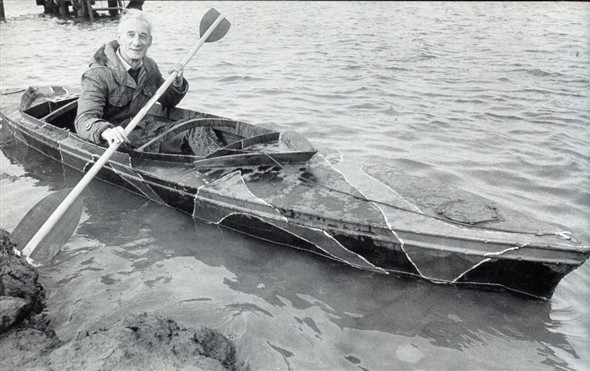
On Sunday the 25th August, 2013, a plaque was unveiled in the museum to commemorate Cpl Bill Sparks D.C.M., by local dignitaries including the Mayor of Castle Point. Many local councillors were in attendance.

Bill Sparks was one of two survivors, alongside Major ‘Blondie’ Hasler, amongst ten men who embarked on ‘Operation Frankton’. These commandos set out with collapsible canoes to plant mines on German ships in Bordeaux, canoeing through miles of water, in the black of the night, to the dock. Many canoes capsized, leaving the men to swim as a death sentence, whilst others were caught and executed by Germans. Only one canoe reached the target containing the two survivors. However, the men were only told what this suicide entailed after they had embarked on the HMS Tuna with the canoes on board.

Bill Sparks retired to Canvey Island in 1971, during his later life, because it was near the sea so he could practice canoeing, which had become a hobby of his. He lived initially in a council estate down Maple Way.

Training in the waters around Canvey for his re-enactment in 1983 (courtesy of CanveyIsland.org)

Training in the waters around Canvey for his re-enactment in 1983
(courtesy of CanveyIsland.org)

SECOND WORLD WAR MAY 1942

SECOND WORLD WAR MAY 1942

(Britain)

British forces begin “Operation Ironclad”, the invasion of Madagascar on the 5th May 1942.  A full frontal attack on the defences at Diego-Suarez on the 6th May 1942 was a failure with the loss of five tanks. The Vichy-French defences took the British by surprise as they were unaware of the level of resistance. The South Lancs. Regiment worked their way round the Vichy defences, despite the swamps, and caused a great deal of chaos when the radio station and one of the barracks were captured. When the radio-set of the South Lancs. failed, communications between them and the main attack force was lost and they were forced to withdraw. HMS Anthony, an old destroyer dashed straight past the harbour defences and broke the deadlock of the highly effective French defence system. Landing fifty Royal Marines in the Vichy rear area they captured the French artillery command post with its barracks and naval depot at Diego-Suarez. With Diego-Suarez secure the British 29th Independent Infantry Brigade, led by Brigadier Oliver Lease headed for the French naval base at Antanamitarana. Assisted by twelve light tanks they advanced the 21 miles overcoming any little resistance with bayonet charges. Lease’s frontal assault forces broke through the Vichy defences and Antanamitarana surrendered on the 7th May 1942. Ten light tanks sent to Madagascar were destroyed. In the three days of fighting the British lost 109 men killed and 283 wounded with the French suffering 700 casualties. In the meantime Vichy forces had asked for Japanese assistance but they were not in a position to help. However, three Japanese submarines arrived three weeks later on the 29th May 1942. A Japanese reconnaissance plane had seen that HMS Ramilies was at anchor in Diego-Suarez Harbour, but she changed berths after the plane was spotted. Two Japanese midget submarines were launched and one entered the harbour and fired a torpedo and seriously damaging Ramilies. The second sank the 6,993 ton oil tanker British Loyalty. Madagascar was finally secured by the Allies when the Vichy forces surrendered on the 6th November 1942.

The attack on the city of Exeter on the night of 3rd/4th May 1942 was another “Baedeker Raid”. The raid was selected by the German Luftwaffe for the city’s cultural and historical significance rather than the strategic or military value. Just after midnight, twenty bombers began the raid which devastated the city centre. The area of Bedford Circus and many adjoining streets were destroyed. The results of the high explosive bombs was the start of many fires which were soon out of control. With the assistance of fire services from Torquay and Plymouth most of the fires were finally under control on the 5th May 1942. The area around the Cathedral was mostly obliterated but the Cathedral itself was hit by an explosive bomb which demolished St. James’ Chapel. The City Library and the Vicars Choral College were destroyed. Of the city’s 20,000 houses, 1,500 were completely obliterated and a further 2,700 badly damaged. The area also suffered the destruction of many shops, offices, warehouses and pubs. A total of 156 people were killed and further 583 were injured. Despite Germany’s radio boast that “Exeter is the jewel of the West, we have destroyed that jewel, and we will return to finish the job” the May 1942 raid was the last suffered by the city.

Soviet Foreign Minister Vyacheslav Molotov arrived in London on the 20th May 1942 for talks that would enable a treaty of alliance be signed between Britain and the Soviet Union. When Molotov met Prime Minister Winston Churchill and Leader of the House of Commons Anthony Eden discussions soon became difficult. The Soviets were pushing for a “Second Front” in order to divert German military resources away from the Eastern Front. Churchill argued, that even with American assistance, Britain was not in a position to launch an offensive across the channel to attack Europe. However, Britain would continue to provide aid to the Soviet Union. Rather than invading Europe for the sake of action at any price, it was deemed better to continue with the aid and not launch an offensive which would end in disaster. On the 21st May 1942 Churchill and Molotov signed the Treaty of Alliance. A proviso was added on the 26th May 1942 that peace with Germany would not be signed by either side without the approval of the other.

Codenamed Operation Millennium the first “Thousand Bomber Raid” by the Royal Air Force (RAF) was conducted against Cologne on 30th May 1942. The massive raid was launched expecting the devastation might be enough to knock German out of the war or at least severely damage German morale. The raid was useful for propaganda purposes for the RAF in that the war was finally being taken to Germany.  Sir Arthur Harris, who was nicknamed “Bomber Harris”, had been appointed Commander-in-Chief (C-in-C) of Bomber Command in February 1942. Bombing raids against Germany prior to the 30th May 1942 were limited owing to the small number of aircraft used and the lack of navigational aids. Later in the war better aircraft and electronic navigational aids increased the accuracy of the raids. Harris was directed by Winston Churchill with Cabinet agreement to carry out “Area bombing” rather than “Strategic bombing” of military targets. The consensus of opinion was that the Nazis had entered the war under the rather childish delusion they were going to bomb everyone else but nobody was going to bomb them. At Rotterdam, London, Warsaw and half a hundred places they put their rather naïve theory into operation. Harris used his now famous quotation, “They sowed the wind, and now they are going to reap the whirlwind”. Because of the losses encountered on the raids of German held territory Britain’s bomber strength was limited after the Battle of Britain. Every individual mission launched resulted in lost aircraft which Britain was struggling to replace. Harris put together a plan to send a 1,000 bomber raid against Cologne. He knew his raid would attract German interceptor aircraft and air defence crews but they would only have short time to attack the bombers. He assembled 416 front-line bombers and crew plus all available second-line and even training crews to attack Cologne’s industrial goods and chemical plants. Churchill approved of the 1,046 bombers attacking the target over a 90 minute period. Approximately 4,500 tons of bombs were dropped on the city crippling industrial output and damaging 600 acres of Cologne. Nearly 500 Germans were killed and approximately 45,000 were left homeless because of the raid. Britain lost 40 bombers but over 1,000 bombers made it back home. 22 year old Lesly Manser VC was piloting an Avro Manchester bomber “D” for Dog and after dropping his quota of bombs he aircraft was caught in the searchlight beams. After being hit by flak which overheated his port engine, he took evasive action to escape the anti-aircraft fire. The rear gunner was wounded and with the front cabin filled with smoke he attempted to get the aircraft and crew to safety. He was over Belgium when the port engine burst into flames, a crash was inevitable, refusing a parachute be ordered his crew to bail out. Staying at the controls he secured his crew’s safety by sacrificing himself. One member of his crew was taken prisoner, but the remaining five crew members evaded capture and made their way back to Britain. Their testimonials were instrumental in the posthumous award of the Victoria Cross for Lesley Manser. However, despite the losses the Allied leaders were not concerned over the outcome of the raid as Harris expected to receive losses. British cities had been forced to endure similar raids during the Blitz of late 1940/early 1941.

(Germany)

On the 10th May 1942 German Generalfeldmarschall Albert Kesselring informed Fuhrer Adolf Hitler that Malta had been neutralised. As commander of the Luftwaffe in the Mediterranean Kesselring’s information was incorrect as he was apparently unaware of the second delivery of Spitfire fighters.  

The Amerikabomber project plan was submitted to Reischsmarschall Hermann Goering on the 12th May 1942. The concept being that the Luftwaffe should obtain a long range strategic bomber capable of attacking the United States from Germany. It was Hitler’s suggestion that long range attacks against the United States was a feasible proposition and thought the Portuguese Azores islands could be used as a transit airfield. With the Azores approximately 1,000 miles west of Portugal it was thought bombers could be developed to achieve the required results. Four aircraft manufacturers were considered but it was the Junkers JU390 that was selected for production. However, although the project was conducted and various design changes investigated it was finally abandoned for being too expensive. The project was also too reliant on the rapidly diminishing production capacity required for the war in Europe to continue.

Reinhardt Heydrich was a high ranking German SS officer and police official within the Nazi party. He was one of the main architects of the Holocaust, ”The Final Solution to the Jewish question”. Hitler described him as “the man with the iron heart”. In September 1941 Heydrich was appointed deputy Protector of the Protectorate of Bohemia and Moravia which was part of German occupied Czechoslovakia. The Czechoslovak government-in-exile located in London co-operated with British Intelligence and devised Operation Anthropoid to assassinate Heydrich. Two exiled Czechoslovak soldiers were selected and trained by British Special Operations Executive (SOE) to carry out the mission. Jozef Gabčik and Jan Kubiš were parachuted into Nehivizdy east of Prague and the planning of the assassination began. Various plans were discussed but they settled on a car attack in Prague. On 27th May 1942, the car in which Heydrich was travelling, slowed down at a hair pin bend and it was here Gabčik’s Sten submachine gun jammed and did not fire, Rather than speed away Heydrich ordered his driver to stop to confront Gabčik. Kubiš threw a converted anti-tank mine at the car and it landed against the rear wheel. The explosion wounded Heydrich with metal fragments and seat stuffing causing serious damage to his left side. He was transported to Bulovka Hospital and appeared to making a recovery.

The German Authorities issued a directive on the 27th May 1942 that all Jews in occupied Belgium must wear the distinctive Jewish badge. The badge was a yellow star with the letter “J” in the centre. It was to be worn on the left side of the chest. All Jews were also required to carry an identification card stamped with word “Jew” in both the Flemish and French language. The directive for the wearing of the yellow star came into effect on the 3rd June 1942.

On the 29th May 1942 in Nazi occupied Paris Hitler ordered all Jews must wear identification badges on their outer clothing. Propaganda minister Joseph Goebbels advised Hitler the badge should be the Yellow Star of David and in the centre the word “JUDE” written in mock-Hebrew script. The wearing of the identification badge singled the Jews out for future German persecution.

(America)

President Franklin D. Roosevelt signed a bill creating the Women’s Auxiliary Army Corps (WAAC) on the 15th May 1942. U.S. Representative Edith Nourse Rogers of Massachusetts introduced a bill for the creation of WAAC in May 1941, because the threat of war was looming. The condition being, if women served to support the army, they would receive all rights and benefits afforded to soldiers unlike the status of women in the Great War. Following the attack on Pearl Harbour in December 1941, congress approved the bill on the 14th May 1942 and was signed into law by the president the following day, Oveta Culp Hobby was sworn in as the first director on the 16th May 1942, and WAAC was established.

The U.S. 1st Armoured Division arrived in Northern Ireland on the 16th May 1942. They departed on RMS Queen Mary from the Brooklyn Army Terminal on the New York’s Port of Embarkation on the 11th May 1942. Upon arriving in Northern Ireland the division trained on the moors under the command of Major-General Orlando Ward. They transferred to England in October 1942. The 1st Armoured Division, nicknamed “Old Ironsides” was the first armoured division to see battle in the Second World War.

(Eastern Front)

The Battle of the Kerch Peninsular began on the 8th May 1942 when the axis powers of Germany and Romania counter-attacked the Soviet Forces in the Crimean Peninsula. The Crimea is a peninsular located on the north of the Black Sea and the southern tip of the Ukraine which had been under Nazi German control since the beginning of Operation Barbarossa in June 1941. Operation Barbarossa was the German invasion of the Soviet Union. The huge port facility at Sevastopol was defended by the Soviet Union Coastal Army but they were trapped and surrounded by the Germans. Soviet Dictator Joseph Stalin believed the German Wehrmacht was danger of imminent collapse. On the 8th December 1941 he instructed STAVKA, the Soviet Supreme Command, to begin planning for a major offensive to link up with the Coastal army trapped in Sevastopol. By linking up with the defenders at Sevastopol the Soviet Union would liberate the Crimea. Following the Soviet offensive which began on the 29th December 1941 numerous attacks and German resistance followed. The Soviet Black Sea Fleet’s ability to supply the Soviet forces in Sevastopol was severely curtailed, by early May 1942 Sevastopol’s defenders were in desperate need of food and military supplies. On Bustard Hunt, the German codename for the counter-attack, began on the 8th May 1942 where the German forces faced a vastly superior number of Soviet troops. The Soviet defence line extended north to south across the peninsular. The Soviet Army did not expect a major attack as they outnumbered the Axis forces two to one. The Soviets deployed three armies to defend the peninsular, one to the northern front, one to the southern front and one in reserve. On the southern front an anti-tank ditch had been constructed and three lines of defence had been built on the swampy ground. However, they failed to deploy their troops into a well prepared defence in depth. To support the German armoured and motorised attack, strong air cover was required. The Luftwaffe had increased their strength to 800 aircraft and soon the numerically superior Soviet air defences had collapsed. The remaining Soviet air reconnaissance failed to spot the German land force build-up. Within hours the Luftwaffe had knocked out the Soviet southern communication headquarters. When the ground attack began the southern army were not in a position to counter attack and they were forced to retreat. On the 9th May 1942, German engineers finished breaching the anti-tank ditches and the land forces swung north trapping the Soviet northern army against the Sea of Azov. The northern army surrendered on the 11th May 1942 allowing the Germans to pursue the retreating Soviet forces. The speed of the German advance was rapid after the Luftwaffe had destroyed the Soviet air opposition. The Luftwaffe was free to bomb the fleeing Soviet columns and burned Kerch and its harbour on the 12th May 1942. Kerch fell on the 15th May 1942 and on the 18th May 1942 the Soviet Army was in major retreat. The final defeat and destruction of the Soviet ground forces was on the 20th May 1942. In the twelve days of Operation Bustard Hunt the Luftwaffe lost 37 aircraft whilst the Soviets lost 417 aircraft. Operation Bustard Hunt ended on the 19th May 1942 and the Germans conquered Sevastopol six weeks later. German casualties amounted to approximately 7,500 men including 1,700 killed or missing. An estimated 162,000 Soviet soldiers were left stranded following the evacuation by sea of between 37,000 and 115,000 Soviet soldiers. Of the Soviet soldiers left stranded 28,000 were killed and the remainder taken prisoner.

The Second Battle of Kharkov began on the 12th May 1942. Following a winter offensive by the Soviet forces that drove the German troops away from Moscow, the Soviet Army under the command of Marshal Semyon Timoshenko launched an offensive against their German opponents. The winter offensive had established a front line west of Moscow down to a salient slightly south of Kharkov. Stalin had overestimated the Soviet Union’s newly raised army and was also convinced the Germans were a finished force and would collapse by mid-1942. On the 14th May 1942 Hitler ordered air strikes against the salient. After a promising start, Timoshenko’s offensive in the salient was halted by massive German air strikes on the 15th May 1942. With the Soviet army hemmed into narrow area in the salient the Germans launched a pincer attack. The pincer attack to the north of the salient was accompanied with German tanks and began on the 16th May 1942. The lack of heavy artillery was insufficient for the Soviet failure to halt the German tanks and overwhelming German defences. The German infantry were more experienced than the numerically superior but technical inferior Soviet troops in the north. While at the salient Soviet troops were facing heavier air strikes from the Luftwaffe, who had air superiority. By the 18th May 1942 STAVKA suggested the offensive be withdrawn. The Soviet commanders claimed the German offensive was exaggerated and Stalin refused to sanction the withdrawal. When the Germans attempted to encircle the salient from the north on the 19th May 1942 Stalin authorised the abandonment of the Soviet offensive. By the 20th May 1942 the Soviets were conducting a fighting retreat. The German offensive continued and by the 24th May 1942 they surrounded Kharkov. The Soviet troops outnumbered the Germans by about two to one but they couldn’t establish superiority and make the numbers count. The first attempt by the Soviets to break the encirclement was on the 25th May 1942. Blind courage alone and with arms linked the Soviet soldiers charged the German machine guns. Without the need for accuracy the German machine gunners killed hundreds of Soviet troops. With complete air supremacy the Luftwaffe dropped anti-personnel cluster bombs into the salient killing the exposed Soviet infantry in their droves. The surviving Soviet soldiers were forced into a crowded position on the 26th May 1942 and by the 28th May 1942 Timoshenko called a halt to any further Soviet break-out attempts from the encirclement. However, when the Germans finally took Kharkov on the 31st May 1942 less than one in ten Soviet troops were able to break-out. Kharkov was a major setback putting an end to the winter counteroffensive undertaken by the Soviet army. During the Second of Battle of Kharkov the Soviet forces sustained approximately 75,000 killed, wounded or missing and approximately 240,000 Soviet prisoners-of-war. They also lost the bulk of their armour. Estimates indicate the German casualties being 20,000 dead, wounded or missing.

(Mediterranean)

During the Desert Campaign, despite having been forced to retreat in late 1941 General Erwin Rommel, began his spring offensive from the Gazala Line on the 26th May 1942. Rommel, nicknamed the “Desert Fox”, and his Afrika Korps were receiving regular supplies from Libya. One of his objectives would be the capture of the port facilities at Tobruk in order that his supply line would be a lot closer to his attacking Afrika Korps. British Commander-in-Chief of Middle East Theatre General (later Field Marshall) Sir Claude Auchinleck had received a telegram from Winston Churchill to take the offensive in North Africa on the 14th April 1942. With no apparent movement by the 10th May 1942 Churchill ordered Auchinleck to begin the attack in the Desert War When by the 17th May 1942 Churchill had not received a reply he demanded an explanation for the delay, to be despatched before the 20th May 1942. Auchinleck sent a reply on the 19th May 1942 to say the attack was imminent once all his supplies were in place. However, Rommel began his offensive from the Gazala Line on the 26th May 1942 and imposed a significant initial defeat on the British. To boost their defences the British utilised United States Sherman tanks, nicknamed by the Germans “Tommy Cookers” or ‘Ronsons’ (light first click), but they were still forced to retire. A British counter-attack with an ensuing tank battle stalled Rommel’s offensive well short of Tobruk. On the 31st May 1942 Rommel set up a defensive line to the west of Tobruk because he had out-run his supply line. Libya had not been receiving regular supplies from Italy since the RAF’s reinforcement fighters based in Malta were attacking and destroying Italian supply ships. Whereas at the beginning of the month German supplies were reaching their destination, the tables had been turned by the end of the month.

Arriving at Gibraltar for the second time on the 9th May 1942 USS Wasp and HMS Eagle launched 64 Spitfires to fly onto Malta, Of the 64 Spitfires launched 61 aircraft successfully landed on Malta. One plane and pilot was lost on take-off, one plane piloted by Canadian Pilot Officer Jerrold Smith experienced problems with his long range fuel tank and was forced to return to Wasp. His Spitfire was the first to land on an aircraft carrier. One Spitfire and pilot was unaccounted for. Within minutes of landing all the Spitfires were refuelled, re-armed and airborne with fresh experienced pilots. The Spitfires were in the air awaiting the expected air raid whose intention was to destroy them. The ensuing air battle saw 47 German aircraft destroyed or damaged for the loss of 3 Spitfires. After the first delivery on the 20th April 1942 many of the 47 Spitfires delivered to Malta had been destroyed on the ground before even entering combat. For the second delivery lessons had been learned. Disguised as a Vichy-French destroyer Leopold, 100 spare Merlin engines plus ground crews trained on Spitfires along with food and general stores, HMS Welshman arrived at Malta on the 10th May 1942. Extensive preparations for the invasion of Malta had been made by the Germans and Italians, who hoped that an air and an amphibious landing would eliminate the island as an air and naval base. This would secure the Axis forces an uninterrupted flow of supplies to the Afrika Korps in the desert campaign. With Rommel’s successes in the desert campaign the invasion of Malta, code named Operation Bowery, was postponed indefinitely on the 21st May 1942. The landing of soldiers, and the invasion of Malta was finally cancelled in November 1942. By the 31st May 1942 Kesselring’s air superiority had been greatly reduced by the arrival of the Spitfires which had proved effective against the incoming fighters and bombers. Compared to a couple of months previously where Kesselring had several hundred aircraft as his disposal he was down to a combined total of 83 serviceable aircraft.

(Pacific)

When General Douglas MacArthur was ordered by President Franklin D. Roosevelt to evacuate the Philippines he was forced to hand over his command. Major-General Jonathan M. Wainwright inherited the unevitable position of Allied Commander South West Pacific Area. After Major-General Edward P. King surrendered the Bataan Peninsula, Corregidor was the last of the Philippine islands to resist the Japanese. Corregidor and the Bataan Peninsular had been besieged since the end of December 1941 by the Japanese air force bombardment. The garrison on the island consisted of combined units of the U.S. Army, U.S. Navy and locally recruited Filipino soldiers valiantly resisting the bombardment. Following the fall of Bataan on the 9th April 1942 the Japanese artillery began immediate bombardment of Corregidor. The initial landings of the Japanese were not without diffiulties, as the defenders fiercely resisted. The Japanese landed troops and equipment despite the strong sea currents and the layers of oil on the beaches (caused by earlier sunken ships). On the 6th May 1942 Wainwright knew that more Japanese would land at night and in order to save thousands of lives he decided the best course was to surrender. In a radio message to Roosevelt Wainwright said “There is a limit of human endurance and that point has long been passed”. Prior to the surrender the Marine Regimental flag and the National Colours were burned to prevent them being captured. Corregidor’s defeat marked the fall of the Philippines and Asia but the Japanese timetable for the conquest of Australia and the Pacific was severely upset. The 11,000 American and Filipino defenders were escorted away from Corregidor as prisoners of war. However, U.S. Army and Navy nurses (the “Angels of Bataan and Corregidor”) continued to work on Corregidor but were the sent to Santo Tomas Internment Camp in Manilla. Wainwright was held in Manchuria while the remainder were sent to various Japanese prison camps. The conquest of the Philippines was a Japanese victory which had been expected would take two months but in actual fact take five months. The commander General Masaharu Hommer was relieved of command over his inability to conquer the Philippines in the projected time scale.  The Americans and Filipino defeat was the worst in the U.S. military history. The Japanese suffered losses of an estimated 17,000 to 19,000 killed, wounded or missing during the Battle for the Philippines. Approximately 23,000 American and 100,000 Filipino soldiers were either killed, wounded or captured. Wainwright was the highest ranking American officer taken as prisoner of war and remained so until the Japanese surrender in 1945. Upon release from captivity in 1945 both Generals, Wainwright at Corregidor and King at Bataan, expected to be court martialled for disobeying orders not to surrender but were treated as heroes when they arrived back in the United States.  

Burma (now Myanmar) was under British rule since 1st January 1886 with the city of Rangoon the capital. Burma was unprepared and under-sourced to prevent the Japanese offensive and Rangoon fell, owing to the superior numbers of troops and equipment Japan had at her disposal. General William “Bill” Slim led the remnants of the Burma Corps to safety. They marched 900 miles north from Burma to Manipur in India in 100 days. Whilst the retreat was a bitter humiliation it was not a rout as General Slim organised a fighting retreat through dust bowls, jungles and mountains allowing him to always stay ahead of the advancing Japanese. Oil fields were destroyed during the retreat ensuring access to oil was denied to the Japanese. General Slim with his officers plus staff and the remainder of the Burma Corp arrived in India just before the monsoon rains began in May 1942 after beginning the retreat at the end of January 1942.

On the 3rd May 1942 American General Joseph Stilwell decided Burma should be evacuated. In February 1942 Stilwell had been promoted to Lieutenant-General and assigned to the China-Burma-India theatre (CBI) where he had three major roles:-

1) Commander of all U .S. forces in China, Burma and India.

2) Deputy Commander of the Burma-India theatre under Admiral Louis Mountbatten.

3) Military advisor and Commander-in-Chief to Generalissimo Chiang Kai-shek, commander of all Nationalist Chinese forces.            

Between the wars Stilwell served three tours of China where he mastered written and spoken Chinese. He earned the nickname “Uncle Joe” for his concern for the average soldier under his command. He is also remembered as “Vinegar Joe” after he harshly criticised a poor performance during an exercise. When he discovered a subordinate had drawn a caricature of him rising out of a vinegar bottle he had the caricature photographed. He also kept a Latin motto on his desk Illigitimi non Carborundum which translates as “Don’t let the bastard’s grind you down”. From early in his career Stilwell’s short temper and colourful language made him stand out against his fellow officers. He had no patience for inefficiency or stuffiness. It led him to have a deep disdain for the British he worked with in Burma, an attitude that caused problems. When Stilwell first arrived in India it was just in time to experience the collapse of the Allied defence of Burma which denied China all lease-lend equipment.  On the 4th May 1942, the evacuation began. As Commander-in-Chief of Chiang Kai-shek’s military forces, he led the retreat of the 5th and 6th Chinese army together with his administration staff along the Burma Road to India. After a 140 mile march he personally led his staff and the remnants of the Chinese army into Assan in India on the 20th May 1942. By the 20th May 1942 the Japanese conquest of Burma was completed. There is no evidence but it is possible that the “Arcadian Conference” of January 1942 did not match Stilwell’s strategy. The conference concluded that the defeat of Germany in Europe must be the number one priority and the Pacific War secondary. With his disdain for the British it is also possible Stilwell’s complaint to Chiang Kai-shek that Britain was reluctant to fight, was that he may well have dismissed the fact that Britain was overstretched and weary. British and Commonwealth forces were stretched very thinly after having stood alone for two years against the aggression of Nazi Germany and her allies.

From the 4th to 8th May 1942 a major naval “Battle of Coral Seas” was fought by the Imperial Japanese Navy and the combined air and naval forces of the U.S.nd Australia. Historically significant was the fact that the opposing aircraft carriers were involved in the first action in which neither sighted nor fired directly at each other. The Japanese need to strengthen their defences in the South Pacific requiring them to invade and occupy Port Moresby in New Guinea and Tulagi in the Solomon Islands. Early in 1942 U.S. Intelligence in Washington had broken the Japanese naval code and were fully aware of the proposed invasion of Port Moresby and Tulagi. Pre-warned the Allied defenders of Tulagi sighted the oncoming Japanese fleet. The defenders included American, Australia and U.K. forces. Anticipating that the Japanese would attack with superior numbers of troops, the joint commanders ordered the evacuation of Tulagi on the 2nd May 1942. They began the destruction and demolition of their equipment and facilities to deny the Japanese access to them. On the 3rd May 1942, unopposed, the Japanese invasion and occupation of Tulagi was successful.  The U.S. Navy carrier task force and a joint American-Australian cruiser force was sent to oppose the Japanese offensive. On the 4th May 1942 several Japanese warships were sunk or damaged in a surprise attack by aircraft from the U.S. fleet carrier USS Yorktown. On the 6th May 1942, now aware of the presence of the U.S. carriers in the area, the Japanese proceeded to the Coral Seas. On the 7th May 1942 aircraft from both American and Japanese carriers searched for the opposing navy. Japanese aircraft torpedoed aircraft carrier USS Lexington incapacitating her to the point where she had to be scuttled to prevent being captured. Japanese aircraft damaged Yorktown and despite the damage suffered she was able to return and limp into Pearl Harbour for repairs on the 27th May 1942. The repairs were estimated to take two weeks but just 48 hours after arriving receiving hasty repairs Yorktown left Pearl Harbour on the 30th May 1942 in readiness for the forthcoming Battle of Midway. Both sides claimed victory after the Battle of the Coral Seas. The Japanese won the tactical victory in terms of enemy ships lost. America’s losses included one aircraft carrier, an oiler and a destroyer totalling 42,471 tons. The Japanese lost a light aircraft carrier, a destroyer and several smaller ships totalling 19,000 tons. From a strategic perspective the battle was an Allied victory. For the first time the Japanese had not achieved their invasion plan, the capture of Port Moresby in New Guinea. The Japanese failure to capture Port Moresby was a morale booster for the the Allies after a series of defeats during the initial six months of the war in the Pacific.

The South Pacific Territory of Wallis and Futuna, lying to the east of Australia, had been under the protection of France since April 1887. During the early part of the Second World War the islands were administered by the Vichy French government. However, a Free French corvette based in New Caledonia deposed the regime on the 26th May 1942. The Allies controlled the islands when the U.S. Marine Corp landed on the 29th May 1942. They denied the Japanese the chance for occupation.

Prior to the Battle of Midway, a follow-up to Japanese Operation “K” was proposed for the 30th May 1942. The operation was scheduled for Japanese intelligence to locate the U.S. aircraft carriers. The Americans became aware the Japanese were preparing another reconnaissance mission similar to the one employed at Pearl Harbour. They were also aware that the French Frigate Shoals was a possible rendezvous as a refuelling site for Japanese flying boat reconnaissance aircraft. American naval patrols increased, the area mined and two American warships were anchored there. A Japanese submarine reported back to the Japanese navy their findings which prompted a cancellation of the plan. With this cancellation the Japanese were not able to observe the U.S. naval activity or to keep track of the American carriers.

(Other Theatres)

In Canada, the Battle of St. Lawrence began on the 12th May 1942 when German U-boat U-553 torpedoed and sank the British freighter Nicoya. Before departing the Gulf of St. Lawrence to return to routine patrolling in the North Atlantic U-553 also torpedoed and sank the Dutch freighter Leto. The lower St. Lawrence River and the Gulf of St. Lawrence was the primary convoy assembly area for war materials designated for Europe especially for Britain. The Battle of St. Lawrence continued intermittently until October/November 1944. The German Kriegsmarine did not have any formal plans to attack shipping in the area but any attacks were opportunist.

Mexico declared war on Germany on the 22nd May 1942. The reasons for the declaration was that two Mexican oil tankers transporting crude oil to the United States were sunk by German U-boats in the Gulf of Mexico. Relationships between the two had been strained since the Spanish Civil War where both countries supported the opposing sides of the conflict. Mexican troops fought for the Allies with more soldiers engaged in the Philippines rather than Europe. Brazil and Mexico were the only two Latin-American nations to contribute troops during the Second World War.

—————————————————————————

SECOND WORLD WAR April 1942

SECOND WORLD WAR April 1942

(Britain)

The Royal Air Force (RAF) sustained their campaign of strategic bombing of Germany when Cologne was attacked by 263 aircraft on the 5th April 1942. Cologne was chosen because it was within range of the recently introduced radio navigation GEE system. Bomber Command had preferred Hamburg which had a large industrial centre of shipyards, U-boat pens and oil refineries. However, Hamburg was attacked on the 8th April 1942, when a total of 272 aircraft carried out the largest raid to date on a single target with the loss of five aircraft. On another raid on the 17th April 1942 the RAF lost eight aircraft out of 173 which had started 75 separate fires. Rostock’s ocean port was a favourite target for air attacks by the RAF because it was easy to find off the Baltic Sea. The Heinkel aircraft factory was one of the prime war industries that was targeted. From the 24th to 27th April 1942 the city was heavily bombed for four nights in a row.

(Germany)

German public opinion demanded heavy reprisal attacks against British cities following successful RAF raids on Cologne, Hamburg and Rostock. German Führer Adolf Hitler was enraged and on the 14th April 1942 he ordered the Luftwaffe to retaliate. On the same day the Luftwaffe began planning for the “Baedeker Blitz” as a tit-for-tat series of raids to try to persuade the RAF to reconsider the bombing of Germany. The plans proposed selecting cities for their cultural and historical significance rather than their military value. The “Baedeker Blitz” was thought to be influenced by the “Baedeker Guide” which was a reference to the popular travel guide at the time. The first raid was directed against Exeter on the 23rd April 1942 which caused minimal damage. On the 24th April 1942 Exeter was again attacked with over 80 fatalities. The Luftwaffe caused widespread damage and approximately 400 casualties when they attacked Bath on both the 25th and 26th April 1942. Norwich was the next to be attacked on the 27th April 1942 causing 67 deaths from the 90 tons of bombs dropped. 0n the 28th April 1942 York was attacked causing 79 deaths but limited damage.

On the 5th April 1942 Hitler issued Führer Directive 41 for the summer offensive in Russia on the Eastern Front. The directive summarised the goals of “Operation Blue” (Fall Blau). Commander General Friedrich Paulus would lead the assault of The Sixth Army on Stalingrad. Hitler set the date for the capture of the city as being the 25th August 1942.

Anton Schmid was executed by the Germans on the 13th April 1942 for saving Jewish lives during the Holocaust. Schmid was born in Vienna, Austria, in January 1900 and was brought up as a devout Roman Catholic and was an electrician by profession. He was drafted into the German Army in September 1939 but because of his age he was basically a civilian in uniform. In August 1941 he was transferred to Vilnius, the German occupied zone of the Soviet Union, where he was employed by reassigning German soldiers separated from their units. In September 1941 he witnessed the execution of 3,700 Jews in the Ponary Massacre. Schmid did not set out to help Jews in the Ghettos but because of their appeals for help his rescue actions began by his helping the Jewish resistance movement. He was arrested in January 1942 and at his trial he was found guilty and executed on the 13th April 1942. It is thought he managed to save an estimated 250-300 Jews but because his trial records did not survive, who denounced him or what offenses he was charged with will never be known.

On the 17th April 1942, French General Henri Giraud, who was captured in 1940, escaped from a castle prison at Königstein, Germany. He made his escape by lowering himself down the castle wall and jumping on a moving train, which takes him to the French border. Hitler, outraged, ordered Giraud’s murder upon being caught, but the French General was able to make it to North Africa via a British submarine. He joined the French Free Forces under General Charles de Gaulle and eventually helped to build the French army.

The German Ministry of Aviation had proposed a scheme whereby long range bombers were capable of attacking America from Germany and using the Azores as a transit airfield should be built. The finalised thirty-three page draught for the German Amerikabomber design competition was completed on the 27th April 1942. Ten copies of the proposal were available for submission, however, these plans were abandoned as too expensive.

Hitler summoned Italian dictator Benito Mussolini and Italian Foreign Minister Ciano Puch to Salzburg on the 29th April 1942. The conference enabled the two leaders to discuss the strategy of the Axis Powers in the Mediterranean and the Eastern Front. When the problem of manpower reinforcements was discussed, Mussolini agreed to send Italian troops to the Eastern Front. The outline plan for the invasion of Malta was discussed. The concept of an invasion, codenamed Operation Herkules, was approved. A mid-July 1942 date was set for the invasion but was postponed because the commanders of the Army, Navy and Airforce were not in agreement. Eventually the plan was cancelled.

(America)

By the 1st April 1942, owing to the shortage of frigates and corvettes acting as suitable escort vessels, the U.S. was slow to adopt the convoy system. When Germany and Italy declared war on the U.S. in December 1941 the Axis submarines entered the “Second Happy Time”. This period saw the submarines attacking Allied vessels and merchant shipping along the Eastern Seaboard of America. The only problem for the Axis submarines was that the patrol period in U.S. waters was only a couple of weeks. After that they had to conserve sufficient fuel to return home across the Atlantic. The “Second Happy Time” lasted until about August 1942 whereby they sank 609 ships totalling 3.1 million tons for the loss of only 22 U-boats. This period equated to approximately one quarter of all Allied shipping losses during the whole of the Second World War.

The Pacific War Council was formed on the 1st April 1942 in Washington DC, and consisted of representatives from America, Britain, Canada, Australia, New Zealand and China to control the Allied war effort in the Pacific and Asian Campaigns. The council never had any direct operational control following the closing down of the American-British-Dutch-Australian Command (ABDACOM) in February 1942.  However, any decisions made were referred to the combined U.S.-British Chiefs of Staff. The United States government had effective control and strategy in the Pacific war owing to the sheer volume of military materials it was supplying to the Allies. By the time the Pacific War Council was formed there were relatively few U.S. forces in the Pacific but that would soon change.

When America entered the war in December 1941, the Wickes Class Destroyer USS Roper was part of the Atlantic Fleet. In early February 1942 she completed a convoy escort to Londonderry, Ireland then returned to the American east coast for patrol and escort duties. Whilst on patrol, off the coast of North Carolina, during the night of the 13th/14th April 1942 Roper closed on an unknown contact to establish its identity. The contact was the surfaced German U-boat U85. A torpedo fired by U85 missed Roper and the ensuring chase ended with the sinking of U85 by gun fire. Fearing a second U-boat attack, Roper delayed rescue operations until daybreak. U85 lost twenty-nine sailors who were buried with full military honours at Hampton National Cemetery, Virginia. USS Roper was the first U.S. naval vessel to sink a German U-boat in the war. Roper’s commanding officer, Lieutenant Commander Hamilton W. Howe received the Navy Cross for this engagement. Roper served in three theatres of war for which he received Battle Stars. The Atlantic Campaign with one star, the European/African/Middle East Campaign with two stars and the Asiatic/Pacific Campaign with one star. The Battle Star was an award issued to U.S. Navy ships for participating in the various theatres of war. Very few U.S. Navy ships were awarded with at least three Battle Stars.

The U.S. Government promulgated black-out restrictions on the Eastern Sea Frontier of the USA on the 18th April 1942. The U.S. Naval Command were concerned that the bright lights on the seafront would create silhouettes of Allied supply ships making them vulnerable targets for German U-boats. Street lights were to be covered in order to only allow a small light to be cast straight down. All bright lights on the seaward side were to be switched off or screened so as not to be visible directly from the sea up to a range of two miles.

(Mediterranean)

April 1942 was a devastating month for Malta. Force “K” was the name of three separate British Royal Navy task forces. The first task force operated against Axis commerce raiders and to intercept their efforts to stop Malta’s supply ships. The second task force operated against Axis convoys sailing from Italy to Libya. Sustained Axis air attacks led to Force “K” being reduced and on the 8th April 1942 the last ship of the force was withdrawn. Malta desperately needed more fighters to combat the Axis air attacks. The lack of supplies to the island meant that food rations were almost depleted and the population on the brink of starvation. Fuel and military resources were running out to add to the misery. A hand written letter from King George VI to the island’s Governor Lieutenant-General Sir William Dobie dated the 15th April 1942 awarded the island of Malta the George Cross for “heroism and devotion”. The letter read, “To honour her brave people I award the George Cross to the island fortress of Malta to bear witness to a heroism and devotion that will long be famous in history. George RI”. Dobie’s reply sent on the 20th April 1942 to Churchill was seen to be a defeatist message. The message was that “By God’s help Malta will not weaken but will endure until victory is won”.

In an effort to sustain Malta’s air defences a further 47 Spitfires flew onto the island on the 20th April 1942. United States Navy aircraft carrier USS Wasp had joined the British Home Fleet in early April 1942 and departed Glasgow on the 13th April 1942 with the 47 Spitfires on board. This was the first of two deliveries to Malta. Wasp with her British escorting vessels passed through the Straits of Gibraltar on the 19th/20th April 1942. Eleven Grumman F4F Wildcat fighters patrolled over Wasp whilst the Spitfires took off and headed for Malta. With the Spitfires safely launched Wasp retired toward Gibraltar. However, efficient Axis intelligence tracked the Spitfires to their destination. Heavy German air raids destroyed many Spitfires whilst on the ground before they were ready for combat. As a result Wasp was required to make a second ferry to Malta in May 1942.

Field Marshall Sir Claude Auchinleck, nicknamed “The Auk”, was Commander-in-Chief of the Middle East Theatre based in Cairo. “The Auk’s” responsibilities also included Persia and the Middle East as well as the Desert War in North Africa. After the besieged garrison of Tobruk was relieved and German General Rommel’s army had withdrawn to El Agheilla in December 1941, The “Auk” appeared to have believed the enemy had been defeated. British Prime Minister Winston Churchill was desperate for some sort of British victory over the Axis Powers. On the 14th April 1942 he sent a telegram to Cairo for Auchinleck to take the offensive in North Africa.

(Pacific)

The American 164th Infantry Regiment of the North Dakota National Guard, or Task Force 6814, joined the Allied forces on New Caledonia. Task Force 6814 had departed New York and in early April 1942 arrived at Noumea, New Caledonia. Task Force 6814 prepared quickly for debarkation and were rapidly transferred into smaller vessels for the trip ashore and were then dispersed inland. New Caledonia, a French territory, was a critical stop on the supply route to Australia. The French and Australian defences were minimal and Task Force 6814 were there to defend the island from possible Japanese attack. The Japanese were keen to overcome the island because of the harbour, an airfield and it had natural war materials. The raw materials consisted of nickel, chromium and iron as well as an abundance of tropical fruit, timber and a substantial meat and fish canning industry. With the arrival of Task Force 6814 the Japanese were denied the occupation of the island.

With the Japanese having overwhelmed the Philippine islands the only Allied stronghold was the Bataan Peninsula and the island of Corregidor. On the 4th March 1942 President Franklin D, Roosevelt ordered General Douglas MacArthur to evacuate the Philippines. The command of the renamed United States Forces in the Philippines (USFIP) was handed over to Lieutenant General Jonathon Mayhew Wainwright IV. The American and Filipino forces manged to fight off the Japanese in a fighting retreat despite the lack of supplies. By the 2nd April 1942 Japanese troops had trapped them on the Orian-Bagac Line. The Japanese all-out assault on Bataan began on 3rd April 1942 when the air force bombed the stronghold with the assistance of 3,000 artillery pieces. By the 5th April 1942 Japanese forces overwhelmed Mt. Samat but the defenders still resisted. The American forces attempted a last offensive on the Japanese on the 8th April 1942. On the same day the U.S. senior commander on Bataan was Major General Edward P. King, who was convinced further resistance was futile and proposed capitulation. The following morning, the 9th April 1942, King met with Japanese Major General Kameichiro Nagano and after several hours of negotiations the American and Filipino defenders of the Bataan Peninsular surrendered. The Radio broadcast on the 9th April 1942 was that “Bataan had Fallen”.

 “The Bataan Death March” began. As the commanding officer in Bataan, Major General King was one of approximately 75,000 U.S. and Filipino personnel who surrendered to the Japanese. He was to suffer the same privations and suffered as brutally as those under his command. He was held in captivity for over 3 years. The prisoners were rounded up by the Japanese and were forced to march some 65 miles from Mariveles, on the southern end of the Bataan Peninsula to San Fernando. The prisoners and approximately 38,000 equally weakened civilian non-combatants were starved, sick and debilitated after weeks of siege conditions. The march took around five days and groups of 100 were escorted by their captors. The marchers were starved and beaten and those too weak to walk were bayoneted. It is believed that because of the brutality of their captors, thousands of troops died but exact figures are unknown. Survivors of the march were taken from San Fernando to prisoner-of-war camps, where thousands more died from disease, mistreatment and starvation. Japanese military culture, at the time, was that to surrender was dishonourable and death was preferred rather than be taken prisoner. They despised any enemy who surrendered and treated them harshly. Upon release from captivity in 1945, Major General King at Bataan and later LT. Gen. Wainwright at Corregidor, both expected to be court martialled for disobeying orders not to surrender but both were treated as heroes when they arrived back in the United States.

The island of Corregidor in Manilla Bay remained the final obstacle and point of resistance against the Japanese Imperial Army. By not securing the island of Corregidor the Japanese would be denied the use of the finest natural harbour in the Far East, Manilla Bay.

With the fall of Bataan on the 9th April 1942 all organised opposition by the U.S. Army Forces East ended. Japanese artillery bombardment on Corregidor began immediately after the fall of Bataan on the 9th April 1942. More Japanese guns were brought in and the Japanese shelling became even more intense over the next few weeks. General Wainwright prohibited counterbattery shelling for three days, fearing there were wounded POWs on Bataan who might be killed. The combined strength of the islands of Corregidor totalled 14,728 American and Filipino military and civilian personnel. The defenders were living on starvation rations and drinking water was only distributed twice a day. Constant bombing and shelling often interrupted the distribution of rations. The carcasses of horses killed by the bombardment was eaten to supplement their food supply. Under orders from the army, seven private ships sailed toward Corregidor from Cebu Island with a supply of food. Out of the seven, only one ship, MV Princessa, reached the island. Corregidor fell in May 1942.

The Australian-administered Territory of New Guinea was a part of the Dutch East Indies. With the dissolution of ABDACOM in March 1942 the Japanese had occupied the Dutch East Indies. When the Japanese achieved their first landings on New Guinea on the 2nd April 1942 the island came under Japanese occupation. By the 6th April 1942 the Japanese Navy began landing troops ashore on Manus Island, which is located north-east of New Guinea in the Bismarck Sea. The Japanese were to occupy New Guinea and Manus Island until the end of the war.

When Field Marshal William (Bill) Slim was promoted to command the Fourteenth Army Ist Burma Corps in March 1942, it was shortly before the Japanese attack on Burma on the 3rd April1 1942. Slim led the 900mile retreat to India and stayed ahead of the advancing Japanese who captured Migyaungye on the 12th April 1942, during the Burma Campaign. By the 15th April 1942 the 1st Burma Corps began destroying the infrastructure of the oilfields at Yenangyaung to prevent the advancing Japanese capturing them intact. With the capture of Lashio on the 29th April 1942 the Japanese cut off the Burma Road, which had been used to supply the Chinese during the 2nd Sino/Japanese War.

In the Indian Ocean the island of Ceylon (Sri Lanka) was strategically important as it controlled vital Allied shipping routes to the Middle East and Australia. Since the fall of Singapore, British authorities anticipated the Japanese would capture Ceylon to disrupt British supply routes. British Intelligence correctly assessed the Japanese intention and Ceylon was hastily garrisoned by Australian troops returning from North Africa. Aircraft carrier HMS Indomitable was relieved of naval duties to serve as a high-speed shuttling facility by ferrying available planes to Ceylon. Newly appointed Commander-in-Chief of the Eastern Fleet, Admiral Sir James Somerville arrived at Colombo on the 24th March 1942. British Intelligence had forewarned the Eastern Fleet of the impending attack and subsequently the fleet evacuated the harbour before the Japanese raid.  However, on the 5th April 1942 the Japanese Navy attacked the port of Columbo where they expected to destroy the British Eastern Fleet. Most of Ceylon campaign was conducted at sea with both navies searching for each other. The Japanese failed to destroy, or even locate the main bulk of the British Eastern Fleet. They did, however, inflict massive damage to the port facilities at Colombo and Trincomalee, destroyed a third of the land based fighters and nearly all of the land based strike aircraft. One small aircraft carrier and two cruisers, together with twenty-three merchant ships were sunk and the Japanese achieved this amount of damage for the loss of twenty aircraft. Although militarily the Japanese navy was victorious, the campaign was short lived. British intelligence detected the Japanese carrier fleet travelling eastward by the 10th April 1942 as it appears the Japanese did not have short-term plans to follow up on their success. The Japanese aircraft carriers required maintaining and resupplying after months at sea. The difficulty in maintaining front line air units contributed to the decision to return east as the war in the Pacific was rapidly becoming in need of Japanese naval attention.

To demonstrate that the Japanese mainland was vulnerable to an American air attack, Lieutenant Colonel James Doolittle led an air raid which was known as the “Doolittle Raid” against Tokyo on the 18th April 1942. Sixteen B-25B Mitchell two engine bombers were launched from the U.S. Navy’s aircraft carrier USS Hornet whist deep in the Western Pacific Ocean. The bombers flew without fighter escort the 2,400 nautical mile raid. The B25 had a normal range of 1,300 miles and needed modifications to enable allow extra fuel to be carried for the mission. The plan called for the bombers to attack military targets in Japan and fly on westward to land in China. Each B25 had a five man crew and carried four 500lb, bombs, one of which was an incendiary bomb. The bombers arrived over Japan about noon, Tokyo time, and bombed ten military targets in Tokyo, Yokosuka, Nagoya, Kobe, Osaka and Yokohama. The raid caused minimal material damage to Japan but it did kill about 50 and injured another 400 military and civilian people. It did, however, have major psychological effects as it raised doubts about the military’s ability to defend the home islands. The attack was an important boost to American morale and served as retaliation for the attack on Pearl Harbour. Fifteen of the sixteen B25s crash landed in China while the last B25 running low on fuel landed at Vladivostok in the Soviet Union. It was immediately confiscated and its crew were interred for over a year. Of the eighty crew members, seventy seven survived the mission. Three men were executed by the Imperial Japanese Army troops following the capture of eight crew members in Eastern China. By having lost all his aircraft, Doolittle expected to be court-martialled, but instead received the Medal of Honour and a two rank promotion to brigadier general.

(Other Theatres)

In Canada on the 27th April 1942, Prime Minister William Lyon Mackenzie King introduced a plebiscite to the nation with regards to conscription. King had been elected Prime Minister in 1940 on the premise that Canada would not be involved in another European war. When France fell in 1940, Canada introduced conscription for home service only, but only volunteers who wished to serve overseas were allowed to go. The plebiscite was a referendum of sorts asking the nation whether they wished to be involved in conscription. This relieved King of the commitment he had made during the election campaign of 1940. To assist the nation over the plebiscite King made a speech in the Canadian House of Commons on the 10th June1942 where he commented that is policy was “not necessarily conscription, but conscription if necessary”. Over 70% of French Canadians in Quebec voted against conscription. The overall majority of the population was 66% in favour of conscription. Quebec’s strong majority against conscription prompted King not to pursue the issue until later when events necessitated a change of policy.

The Battle of Madagascar began when British assault troops departed Durban in South Africa on the 28th April 1942. The island of Madagascar was controlled by the Vichy French and therefore part of the Axis Powers. Madagascar’s capture was vital to the Allies to prevent the Imperial Japanese Navy having a base close to the Allied shipping routes to India, Australia and Southeast Asia. The amphibious assault on Madagascar included Allied naval, land and air forces. The naval contingent consisted of over fifty vessels commanded by South African born Admiral Sir Edward Syfret of the Royal Navy. In overall command of the amphibious assault on Madagascar was Major-General Robert Sturgess of the Royal Marines.

—————————————————————